

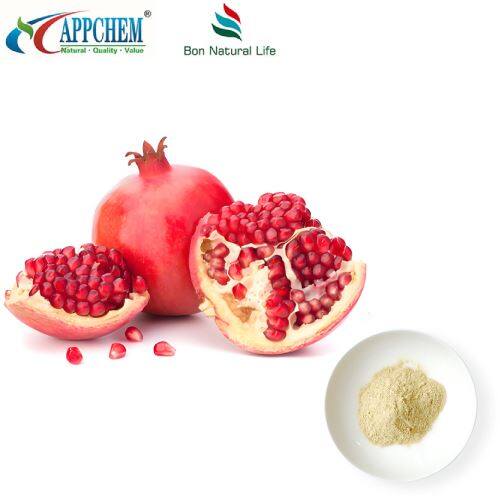
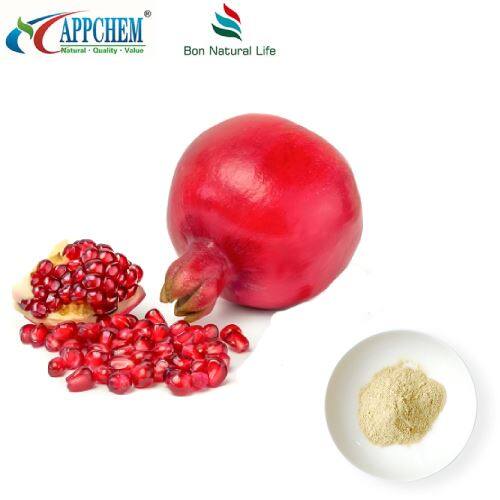
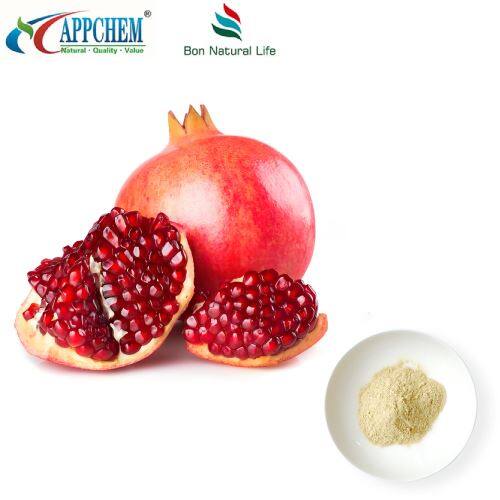
Ellagic Acid Pomegranate Extract is a premium product that is extracted from natural sources. Ellagic acid exists in both free and combined forms in nature, such as ellagitannin, glycoside, etc. Ellagic acid has been linked with numerous health benefits, making it an excellent addition to your personal care products.
1. What is Ellagic Acid?
Ellagic acid (EA) is a natural polyphenolic compound that is a product of the hydrolysis of ellagitannins. It is particularly abundant in pomegranate, strawberry, raspberry, walnut, and walnut. Among them, pomegranate (Punica granatum L.) is recognized as one of the highest quality commercial sources of Ellagic Acid and its precursor, Ellagitannins. Its skin, juice, seeds, and flowers all contain high concentrations of such active ingredients.[1]
Pomegranate, as a long-standing "super fruit", owes much of its health value to its rich polyphenols. Ellagic Acid, as the core functional molecule, exhibits excellent antioxidant activity due to its unique chemical structure of four hydroxyl groups and two lactone rings. It can effectively eliminate free radicals in the body and protect cells from oxidative stress damage.
| Melting point: | ≥350 °C |
| Boiling point: | 363.24°C (rough estimate) |
| Molecular formula: | C14H6O8 |
| Molecular weight: | 302.19 |
| EINECS/ELINCS Registration Number: | 207-508-3 |
|
Structural formula:
|
|

2. Certificate of Analysis(COA)
|
Product Name |
Ellagic Acid |
Botanical Source |
Punica granatum L. |
|
CAS No. |
476-66-4 |
Plant Part |
Peel |
|
ITEM |
SPECIFICATION |
RESULT |
TEST METHOD |
|
Physical Description |
|||
|
Appearance |
Greyish yellow to light yellow powder |
Conforms |
Visual |
|
Odor |
Characteristic |
Conforms |
Organoleptic |
|
Taste |
Characteristic |
Conforms |
Olfactory |
|
Particle size |
98% passes through an 80 mesh sieve |
99% |
CP2020 |
|
Chemical Tests |
|||
|
Ellagic Acid |
≥80.0% |
80.58% |
HPLC |
|
Loss on drying |
≤8.0% |
3.87% |
GB 5009.3 (105 ℃, 3 h) |
|
Ash |
≤3.0 % |
1.91% |
GB 5009.4 (600 ℃, 4 h) |
|
Heavy Metals |
≤20 ppm |
<20 ppm |
GB 5009.74 |
|
Lead (Pb) |
≤2 ppm |
0.012 ppm |
GB 5009.12 |
|
Arsenic (As) |
≤1 ppm |
0.013 ppm |
GB 5009.11 |
|
Cadmium (Cd) |
≤2 ppm |
0.009 ppm |
GB 5009.15 |
|
Mercury (Hg) |
≤1 ppm |
0.011 ppm |
GB 5009.17 |
|
Microbiology Control |
|||
|
Aerobic bacterial count |
≤1,000 CFU/g |
<10CFU/g |
GB 4789.2 |
|
Total Yeast & Mold |
≤100 CFU/g |
<10CFU/g |
GB 4789.15 |
|
Escherichia coli |
Negative |
Negative |
GB 4789.38 |
|
Salmonella |
Negative |
Negative |
GB 4789.4 |
|
Conclusion |
Conforms to specification |
||
|
Storage: |
Store in a cool, dry, well-ventilated area in tightly sealed containers. Keep them full whenever possible. | ||
|
Shelf Life |
24 months when properly stored. |
||
|
Status: |
Non-irradiation; Non-GMO; No Carrier; Halal & Kosher certified. |
||
3. Fingerprint of Ellagic Acid

4. What is the Process Flow Diagram?
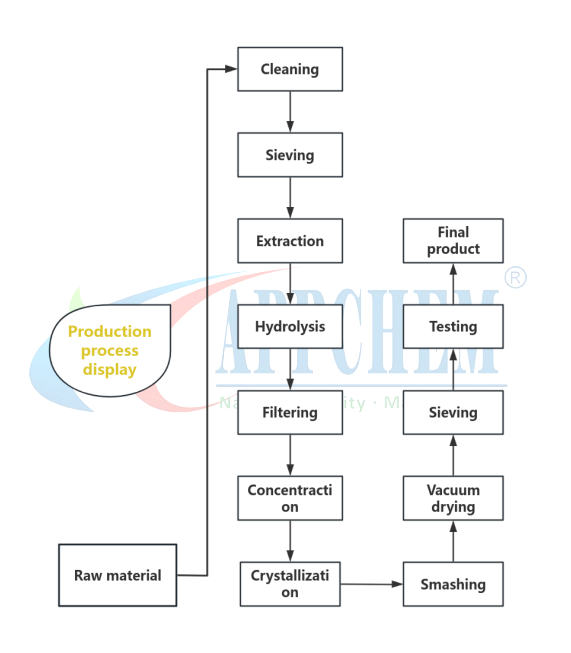
The preparation of industrial-grade high-purity tannic acid powder is a precision process involving multiple steps and intensive technology. The core goal is to efficiently obtain the target product from pomegranate by-products (such as skins) rich in tannic acid tannins through hydrolysis, extraction, separation, and purification. In recent years (2020-2024), research has focused on developing more environmentally friendly, efficient, and scalable production processes.
4.1 Raw material pretreatment
The production process begins with the by-products of pomegranate processing, primarily pomegranate peel, as it has the highest content of tannic acid. Fresh pomegranate peel is cleaned, dried (usually using hot air drying or freeze-drying to maximize the retention of active ingredients), and then crushed into a suitable particle size powder.
4.2 Extraction and hydrolysis
This step is the core of the entire process. Traditional methods primarily rely on organic solvent extraction, accompanied by acid or alkali-catalyzed hydrolysis processes, to decompose large molecules of tannic acid into smaller acids. Among them, a 70% ethanol aqueous solution is widely used in industrial production due to its high extraction efficiency and relatively low toxicity.[2]
4.3 Purification and Refinement
The crude extract obtained from the extraction is a complex mixture containing various components such as tannic acid, pigments, sugars, and organic acids. It must undergo purification steps (centrifugation, filtration, and extraction) to obtain high-quality products. The purified tannic acid solution is concentrated, crystallized, washed, and vacuum-dried to obtain high-purity tannic acid powder products that are off white or light yellow in color.
5. Is Ellagic Acid Effective? How Does It Work?
Product efficacy and mechanism of action


6. Bioavailability: revealing the complexity of absorption and metabolism
Although Ellagic Acid has significant in vitro biological activity, its bioavailability in the human body is a complex and challenging topic.
- The challenge of low bioavailability: Pure Ellagic Acid has poor water solubility and a flat molecular structure that is easy to aggregate, resulting in low dissolution and absorption efficiency in the gastrointestinal tract. Multiple human studies have shown that after oral administration of pomegranate juice or pomegranate extract, the concentration of the prototype ellagic acid detected in plasma is very low.[3]
Research data shows that after ingestion of Ellagic Acid, the concentration of Ellagic Acid in plasma typically reaches its peak around 1 hour.[4] Different dosage forms (e.g., juice or extract powder) can influence absorption rate, leading to variations in Tmax ranging from 0.65 to 2.58 hours.[3]
7. What Are the Applications of Ellagic Acid?
With its clear health benefits and natural source advantages, Ellagic Acid powder derived from pomegranate has a wide range of applications in the dietary supplement market.
| Product Form: | Application |
| Hard capsules/tablets | The most common form. Easy to precisely control dosage, often compounded with other antioxidants (such as vitamin C, E) or specific functional ingredients (such as coenzyme Q10, resveratrol) to produce synergistic effects. |
| Powder/granule | It can be incorporated directly into beverages or foods such as smoothies, yogurt, and juice, providing versatile consumption options. |
| Functional beverages/oral liquids | It can be used as a core ingredient in liquid supplements for anti-aging, beauty, or cardiovascular health. |
| Soft candy | To meet the demand of young consumers for convenient and delicious supplements, Ellagic Acid is integrated into functional gummies. |

8. Why Choose APPCHEM?
Discover the Advantages of Choosing APPCHEM
-
High-Quality Source
Our Ellagic Acid Powder is extracted from high-quality pomegranate plants that are grown in a controlled and organic environment. Raw material selection adheres to strict acceptance criteria, resulting in a rejection rate of less than 2%.
-
Purity and Potency Guaranteed
APPCHEM utilizes a sophisticated pre-treatment process to extract and purify the Ellagic Acid Powder (HPLC 80% - 90%). This process helps preserve the potency and purity of the powder, ensuring it delivers the desired therapeutic benefits.
-
Competitive Pricing
As a direct manufacturer, APPCHEM offers ellagic acid powder from $43/kg (varies with order volume and specification), reducing costs by 11%-17% compared to distributor alternatives. Customized purity and particle size options are available.
9. Certificates

Security statement:
Our company guarantees that the goods sent are safe, non-flammable, and non-explosive, and consistent with the declaration. Under normal transportation conditions, all losses caused by the products sent by our company shall be borne by our company.
Tags: Ellagic Acid Powder, Pomegranate Extract manufacturers, suppliers, factory, wholesale, best, price, buy, for sale, bulk.

Reference
[1]A review on Pharmacological activities, Phytochemistry, Pharmacokinetics study of the different parts of plants (leaves, bark, flower, seeds, peels, and juice) of pomegranate: The Pomegranate (Punica granatum L.), biological properties and important findings: A review. Miss. Ile R.S. et al. [2024-08-11]
[2]CHROMATOGRAPHIC ANALYSIS OF POMEGRANATE PEEL EXTRACTS OBTAINED WITH VARIOUS SOLVENTS. Niyozov Khasan Niyoz ugli. et al. [2025-03-04]
[3]Bioavailability of Ellagic Acid, Urolithin A, and Urolithin B in Human Plasma after Pomegranate Juice or Extract Consumption. Tianmeng Chen. [2016-05]
[4]The anti-obesity effects of polyphenols: a comprehensive review of molecular mechanisms and signal pathways in regulating adipocytes. Lan He et al. [2024-10-30]


