

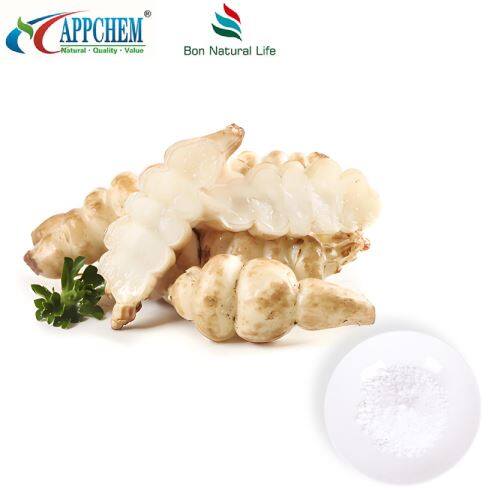
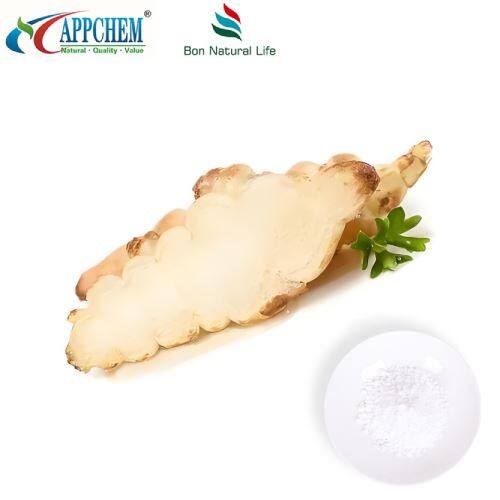
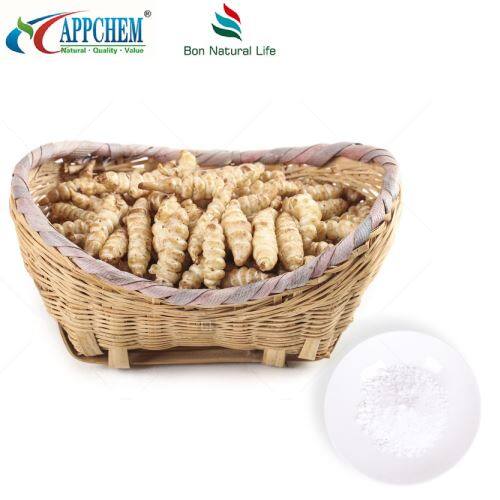
What is Stachyose Powder?
Stachyose is a raw material derived from the herb silkworm (also known as pagoda vegetable or manna seed). After cleaning, slicing, extraction, filtration, concentration, drying, crushing, screening, and packaging, it is processed into white powder products. As a Non-digestible Prebiotic, it selectively stimulates the growth of intestinal microflora, significantly improving the intestinal microbial balance, promoting the synthesis and absorption of Vitamins and trace elements, enhancing immunity, and reducing the risk of cancer, particularly gut cancer. Suitable for usage as food directly or as a functional food ingredient in low-calorie diet foods, diabetes foods, beverages, confectionery, milk products, chewing gums, etc.
|
|
Molecular formula: C24H44O22 |
|
Molecular weight: 684.59 |
|
|
EINECS/ELINCS Registration Number: 207-427-3 |
|
|
Structural formula: |
|
 |

Certificate Of Analysis (COA)
|
Product Name |
Stachyose |
CAS No. |
54261-98-2 |
|
Botanical Source |
Stachys sieboldi Miq. |
Plant Part |
Rhizome |
|
ITEM |
SPECIFICATION |
RESULT |
TEST METHOD |
|
Organoleptic Properties |
|||
|
Appearance |
White powder |
Conforms |
Q/XATM 0001S-2023 |
|
Odor |
Odorless |
Conforms |
Q/XATM 0001S-2023 |
|
Taste |
Sweet |
Conforms |
Q/XATM 0001S-2023 |
|
Impurity |
No visible impurity |
Conforms |
Q/XATM 0001S-2023 |
|
Physical Tests |
|||
|
pH/pH |
5.5~8.5 |
6.82 |
Q/XATM 0001S-2020 |
|
Solubility |
≥98% |
99.09% |
GB/T 20882.6-2021 |
|
Particle size |
NLT 95% through 80 mesh |
98.91% |
CP2020 |
|
Chemical Tests |
|||
|
Stachyose (on dry basis) |
≥80.0% |
82.86% |
Q/XATM 0001S-2023 B |
|
Loss on drying |
≤5.0% |
2.95% |
GB5009.3 |
|
Ash |
≤0.8 % |
0.03% |
GB5009.4 |
|
Lead (Pb) |
≤0.5 mg/kg |
( 0.005mg/kg) |
GB5009.12 |
|
Arsenic (As) |
≤0.5 mg/kg |
( 0.0002mg/kg) |
GB5009.11 |
|
Cadmium (Cd) |
≤1.0 mg/kg |
( 0.001mg/kg) |
GB5009.15 |
|
Mercury (Hg) |
≤0.5 mg/kg |
( 0.0003mg/kg) |
GB5009.17 |
|
Microbiology Control |
|||
|
Total plate count |
≤500 CFU/g |
<10CFU/g |
GB4789.2 |
|
Mold & yeast |
≤50 CFU/g |
<10CFU/g |
GB4789.15 |
|
Coliforms |
≤0.3MPN/g |
<0.3MPN/g |
GB4789.3 |
|
Salmonella |
Negative |
Conforms |
GB4789.4 |
|
Conclusion |
Conforms to specification |
||
|
Storage: |
Store in tightly sealed and preferably full containers in a cool, dry, and ventilated area. |
||
|
Shelf Life: |
24 months when properly stored. |
||
|
Status: |
Non-irradiation; Non-GMO; No Carrier; Halal & Kosher certified. |
||
What is the Process Flow Diagram?

Is Stachyose Powder Effective? How Does It Work?
Benefits for infants and children
Improve constipation and diarrhea: promote calcium, iron, zinc, and other minerals and vitamin absorption;
Enhance immunity;
Prevent eczema;
Prevention of small bowel colitis (NEC).
Constipation and diarrhea are among the most troublesome problems for parents, and the common treatments include Smectite and Medlac-Vita. However, "Every medicament has side effects," and for infants themselves, intestinal micro-ecological development is not mature enough and differs from each other, so these conventional medicines will easily cause constipation, diarrhea, and even worsen the conditions when taken improperly. Fortunately, Stachyose is already approved as an "ordinary food" and works well for dual-directional regulation of infantile constipation and diarrhea.

Benefits for elderly people
Stachyose could better reduce cholesterol, triglyceride, and low-density lipoprotein cholesterol levels while raising high-density lipoprotein cholesterol levels, so it performs well in lipid-lowering.
Stachyose could prevent blood sugar from going up and control the fluctuation within a small range effectively. In addition, studies show that stachyose can also reduce the diastolic blood pressure (mechanism remains unclear but may be related to the proliferation of Bifidobacterium).

What Are the Applications of Stachyose Powder?
1. Stachyose Powder is a common food and can be used as a water-soluble dietary fibre. It is non-toxic and can be eaten directly.
2. Stachyose has a very obvious proliferation effect on beneficial bacteria such as bifidobacteria and lactobacilli in the human gastrointestinal tract, and can rapidly improve the environment in the human digestive tract.
3. Stachyose is not destroyed in the stomach, small intestine, and other organs of the human body, and can directly reach the large intestine, where the beneficial intestinal bacteria are located, significantly promoting the proliferation of bifidobacteria.
4. Stachyose can promote the synthesis of B1, B2, B6, B12, and other vitamins, and promote the absorption of calcium, magnesium, and other elements in the gastrointestinal tract.
5. Stachyose is not a substance that acts on flatulence. It does not produce abdominal distension after taking it, and it quietly moisturises the gastrointestinal tract.
6. Stachyose has active factors that can absorb toxic substances and pathogenic bacteria in the gastrointestinal tract, thereby enhancing human immunity.
7. Stachyose has been gradually adopted and widely used in the pharmaceutical and healthcare industries.

Certificates

Security statement:
Our company guarantees that the goods sent are safe, non-flammable, and non-explosive, and consistent with the declaration. Under normal transportation conditions, all losses caused by the products sent by our company shall be borne by our company.
Tags: Stachyose Powder, Stachyose manufacturers, suppliers, factory, wholesale, best, price, buy, for sale, bulk.

Factory Overview
XI'AN APP-CHEM BIO (TECH) CO., LTD.
Bon Natural Life(Nasdaq: BON)
The Company is headquartered in Xi'an High-tech Zone, Shaanxi Province, with an independent R&D center and testing laboratories. Its Dali and Tongchuan production sites cover a total area of nearly 20,000 square meters, and it operates through the marketing networks in and out of China.
DALI FACTORY
- Covering 30 acres and a building area of 11000 m²
- Having a plant extract workshop, a precision drying and packaging workshop, and a spice refining workshop
TONGCHUAN FACTORY
- Covering 20 acres, with a construction area of 6900 m²
- Having 3 clean workshops, 2 formula product production lines, and 1 special food production line under construction.

2006
Foundation
17,900 m²
Building area
90M
Order received
30+
Patents
FAQ
Q: What is the difference between raffinose, oligofructose, and oligogalactose?
A: Stachyose is a tetrasaccharide structure with a degree of polymerization (DP) of 4, while oligofructose has a DP of 2-8 and oligogalactose has a DP of 2-6 (according to a review of Chinese food additives in 2023). Shusu sugar has a higher selectivity for bifidobacteria, with a proliferation effect 2-3 times that of oligofructose, lower gas production, and a 60% reduction in abdominal distension incidence. In addition, stachyose has stronger stability in gastric acid, with a retention rate of over 95% when reaching the colon, while oligofructose is only 60% -70%.
Q: What is the recommended daily intake? How long does it take to take effect?
A: According to safety evaluations and trial data, the recommended daily intake for healthy adults is 2-3 grams per day, and for those with constipation or intestinal dysfunction, it can be increased to 5-10 grams per day. Generally, improvement in bowel movements can be observed after taking it continuously for 7-10 days. After 4 weeks, the number of bifidobacteria in the intestine significantly increases, and after 8 weeks, the indicators of glucose and lipid metabolism improve. It is recommended that first-time users start from 2 grams per day and gradually increase to the recommended amount.
Q: Can diabetes patients take it?
A: Absolutely possible. Stachyose is not decomposed by human digestive enzymes, contains no absorbable sugar, has no effect on blood sugar and insulin, and has a GI value of zero (according to the research of the China Journal of diabetes in 2020). On the contrary, stachyose can improve insulin resistance and assist in blood glucose control by regulating gut microbiota. However, it should be noted that some commercially available raffinose products may contain other additives. It is recommended to choose pure products of high quality.
Q: Will taking it cause bloating and diarrhea?
A: The safe dosage window for stachyose is wide. Research has shown that daily intake of less than 0.3 g/kg body weight (18 grams for an adult weighing 60 kg) does not cause significant bloating. Sensitive individuals may experience mild bloating in the early stages, which is a normal response of the gut microbiota during the adaptation period and usually resolves on its own after 3-5 days. It is recommended to take it with meals or in divided doses to reduce discomfort.
Q: Can children and pregnant women take it?
A: YES. It is recommended to reduce the dosage by 0.5-1 grams/day to improve constipation and enhance immunity in children. Pregnant and lactating women are recommended to use it under the guidance of a doctor or nutritionist. Although there are currently no clear contraindications, relevant safety data is limited. Patients with congenital galactosemia should avoid using it, as stachyose may be broken down by gut microbiota in the body to produce galactose.
Reference
[1]The source, extraction, purification, physiological function, and application of stachyose in the food industry. Xitao Ta. [2022-03-07]
[2]Genus Stachys: A Review of Traditional Uses, Phytochemistry and Bioactivity. Ekaterina-Michaela Tomou et al. [2020-08-11]
[3]Characterization of Volatile Compounds and Evaluation of Antibacterial, Antifungal, and Cytotoxic Properties of Stachys palaestina from Palestine. Jaradat. [2024-01-01]
[4]Industrial production method for extracting stachyose from radix rehmanniae. [2014-07-31]
[5]Audit Report Global Standard for Food Safety Issue 7: July 2015. Lloyd's Register LRQA. [2017-06-14]
[6]L. Hough. "Sucrose Properties and Applications: Edited by M. Mathlouthi and P. Reiser, Blackie Academic and Professional, Glasgow, UK, 1995. ISBN 0-75-140223-0, 254pp, £79.00." Carbohydrate Research (1996). [1996-08-19]


