

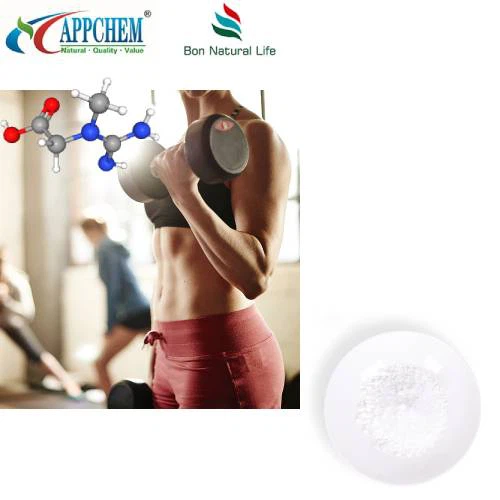
1. What is Creatine Monohydrate?
Creatine is a nitrogen-containing organic acid, or more simply, a chemical compound that occurs naturally in animals. So creatine is a compound that exists in the body, not a man-made hormone or steroid. 95% of the creatine in the human body is in the skeletal muscles, and the remaining 5% is in the brain, liver, kidneys, and testes. The total creatine content in the body is achieved by extraction from food plus secretion by the liver. Foods high in creatine include all kinds of meat, especially beef.
Molecular formula: C4H9N3O2
Molecular weight: 149.15
EINECS/ELINCS Registration Number: 611-954-8
Structural formula:

2. Certificate of Analysis(COA)
|
ProductName |
CreatineMonohydrate |
MeshSize |
200Mesh |
|
CAS No. |
6020-87-7 |
CountryofOrigin |
China |
|
Item |
Specification |
Results |
TestMethods |
|
Assay |
NLT99.5% |
99.94% |
HPLC |
|
Appearance |
Whitepowder |
Whitepowder |
Visual |
|
Lossondrying |
NMT12.0% |
10.60% |
USP<731> |
|
Residueonignition |
NMT0.1% |
0.05% |
USP<281> |
|
Bulkdensity |
NLT400g/L |
515g/L |
USP<616> |
|
Tappeddensity |
NLT550g/L |
628g/L |
USP<616> |
|
Creatinine |
NMT50ppm |
Conforms |
LiquidChromatogram |
|
Sulphate |
NMT0.03% |
Conforms |
Colorimetry |
|
Dicyanamide |
NMT20ppm |
Conforms |
LiquidChromatogram |
|
TestofSulfuricAcid |
NoCarbonation |
Conforms |
Eyeballing |
|
Cyanide |
NMT1ppm |
Conforms |
Colorimetry |
|
Impurity |
NMT1% |
Conforms |
Compute |
|
Heavymetals |
NMT10ppm |
Conforms |
USP<231> |
|
Lead |
NMT1ppm |
Conforms |
AAS |
|
Arsenic |
NMT1ppm |
Conforms |
AAS |
|
Cadmium |
NMT1ppm |
Conforms |
AAS |
|
Mercury |
NMT0.1ppm |
Conforms |
AAS |
|
Totalplatecount |
NMT1000cfu/g |
Conforms |
USP<61> |
|
Yeast&Mould |
NMT100cfu/g |
Conforms |
USP<61> |
|
E.Coli |
Negative/10g |
Conforms |
USP<61> |
|
Salmonella |
Negative/10g |
Conforms |
USP<61> |
|
Staphylococcusaureus |
Negative/10g |
Conforms |
USP<61> |
|
Conclusion |
Conform to enterprise standards. |
||
|
Packing&Storage |
Packed in paper drums.25kg/carton Store in a well-closed container away from moisture and sunshine. |
||
|
Shelflife |
Twoyearsifstoredundertheconditionsaboveandstayinoriginalpacking. |
||
3. What is the Process Flow Diagram?

4. Is Creatine monohydrate Effective? How Does It Work?
The efficacy of creatine monohydrate goes far beyond simply providing energy. Its mechanism of action is multidimensional and multi-level, which is the fundamental reason why it can exert beneficial effects in various physiological scenarios.
4.1 Main benefits: Improve athletic performance and promote muscle adaptation
- Enhance strength and explosiveness: By increasing the reserve of phosphocreatine (PCr) in muscles, creatine can significantly improve the ATP regeneration rate during high-intensity, intermittent exercise. This means that athletes can complete more repetitions, use larger loads, or maintain higher power output during continuous sprints. 【158】
- Promote muscle growth (muscle hypertrophy): Creatine, as an osmotically active substance, enters muscle cells and brings in water, increasing cell volume. This' cell swelling 'not only directly increases muscle circumference, but more importantly, it is considered a synthetic metabolic signal that can stimulate protein synthesis and inhibit protein breakdown. 【62】
- Regulating myogenesis related pathways: Studies have shown that creatine supplementation can upregulate the activity and quantity of satellite cells (muscle stem cells), and affect key signaling pathways such as mTOR, as well as upregulate the expression of myogenic regulatory factors such as myoglobin and MRF4, which are core molecular events for muscle repair and growth.
- Recovery and reduction of muscle injury after accelerated exercise: Subjects supplemented with creatine showed faster muscle strength recovery and lower levels of injury markers such as creatine kinase (CK) and lactate dehydrogenase (LDH) in their serum after experiencing centrifugal exercise-induced muscle injury.
4.2 Expanded Benefits: Cognitive Health and Clinical Application Potential
- Improving cognitive function: Especially in stress states or for individuals with low levels of creatine in the body, supplementing creatine shows the potential to improve short-term memory, reasoning ability, and attention. The mechanism is to provide neurons with more abundant energy and maintain the functional stability of the brain under cognitive load.
- Neuroprotective effect: Creatine may play a protective role in neurodegenerative diseases (such as Parkinson's disease, Huntington's disease) and traumatic brain injury, which is related to its ability to resist oxidation, stabilize mitochondrial function, and maintain cellular energy homeostasis.
- Elderly health and anti-sarcopenia: Combining resistance training with creatine supplementation in the elderly can significantly increase muscle mass, strength, and functional activity performance (such as the speed of standing up from a chair) compared to training alone. This makes it a highly valuable nutritional intervention in the strategy of active healthy aging.

5. What are the Applications of Creatine Monohydrate?
Pharmaceutical raw materials and health product additives. It can inhibit the generation of muscle fatigue factors, reduce fatigue and tension, restore physical fitness, accelerate human protein synthesis, make muscles stronger, enhance muscle elasticity, reduce cholesterol, blood fat, and blood sugar levels, improve muscular atrophy in middle-aged and elderly people, and delay aging. Widely used in food, beverages, additives, etc. Pharmaceutical raw materials and health product additives. It can inhibit the generation of muscle fatigue factors, reduce fatigue and tension, restore physical fitness, accelerate human protein synthesis, make muscles stronger, enhance muscle elasticity, reduce cholesterol, blood fat, and blood sugar levels, improve muscular atrophy in middle-aged and elderly people, and delay aging.

6. What are the side effects of Creatine Monohydrate?
So far, there are 700+ scientific studies on creatine, so creatine is the most researched sports supplement product, and it is also the most effective and safest one. However, in a small number of studies, scientists have found that creatine does have some side effects.
Side Effect 1: Weight Gain
Creatine can cause weight gain because creatine causes the body to retain more water, which increases overall body mass. But for some people, the weight gain may make them less fit or push some athletes above their sporting weight class. So, weight gain can also be seen as a side effect.

Side Effect 2: Stomach Discomfort?
So far, there are not enough effective studies to prove that the consumption of creatine can cause gastrointestinal disorders. However, there are a small number of single-case reports that the consumption of creatine may cause gastrointestinal upset, leading to nausea, vomiting, and diarrhea. Researchers believe these are caused by consuming too much creatine at one time, and as long as you make sure you don't exceed 5 grams per serving, you should be fine. Because creatine attracts water, if you eat 10-20 grams of creatine at one time, it will absorb a large amount of water in the stomach, and a large amount of water may cause diarrhea and loose stools. This is why I did not recommend taking creatine during the shock phase above.
In addition, in the above studies, the scientists were unable to control the diet of the experimenters, so the possibility that the diet of the experimenters caused gastrointestinal problems cannot be ruled out.
Summary:
According to the existing evidence, as long as there is no shock period and each consumption does not exceed 5 grams, creatine is less likely to cause gastrointestinal discomfort, so there is no need to worry about creatine increasing the burden on the stomach.
7. FAQ
Q1.Since creatine is a compound that already exists in the body and is also found in food, why should it be supplemented by supplements? Why not fill it up with some extra beef?
A: Because the amount of creatine in the body and food is not enough, athletes can improve their improvement of sports performance. Moreover, the meat will lose 30% of its creatine during the burning process, and beef is also very expensive. Therefore, it is a very good choice to supplement the total creatine content through supplements.
Q2. Can creatine be taken with caffeine?
A: There isn't enough research to prove that caffeine counteracts the performance-enhancing effects of creatine. Therefore, caffeine can be taken with creatine.
Q3. When is the best time to consume creatine?
A: Scientific research has found that if creatine is placed after training, it is more conducive to the absorption and muscle-building effect of creatine, because insulin sensitivity is higher after training, and the function of insulin is to help cells absorb nutrients faster. Also, generally speaking, after training is the time when carbohydrate intake is the highest, and carbohydrates will stimulate the secretion of insulin, so creatine is best eaten after training.
Q4. Does creatine need a shock period?
A: Unnecessary. The impact period will be a waste of creatine because the absorption rate of creatine is very low; the more each intake, the lower the absorption rate. Additionally, scientists believe creatine's side effects are likely caused by the shock period.
Q5. How many grams of creatine do you eat every day?
A: Eat 5 grams per day.
Q6. Do I need to stop taking creatine for some time?
A: Need not. Hit or no hit, there's no need to stop taking creatine. It's perfectly fine if you want to stop; you'll just lose a little bit of strength and weight.
Q7. When is the best time to eat creatine?
A: It is recommended to eat during training time, either before or after training.
Q8. Can creatine be taken with protein powder?
A: Can.

Summarize
1. Creatine is one of the most researched, proven effective, and safest sports supplements to date.
2. Creatine is a compound that exists in animals, not a man-made hormone or steroid.
3. Creatine can increase energy storage within muscle cells, thereby enhancing exercise performance.
4. Creatine can also increase the number of satellite cells and the content of nuclei, thereby helping to build muscle.
5. Creatine does not require a shock, nor does it need to stop taking it; just take 5 grams a day.
6. If you want to see the effect of creatine, the content of creatine in the muscle cells must be saturated first, so it takes a period (1-3 weeks) to see the effect.
7. There is a case report that creatine has certain side effects, but there is not enough effective scientific research to prove that these side effects are caused by creatine. Scientists believe these side effects can be avoided by making sure each serving does not exceed 5 grams and drinking plenty of water after starting creatine.
8. Creatine can be taken with caffeine.
9. Creatine does not cause hair loss.
8. Certificates

Security statement:
Our company guarantees that the goods sent are safe, non-flammable, and non-explosive, and consistent with the declaration. Under normal transportation conditions, all losses caused by the products sent by our company shall be borne by our company.
Tags: Creatine Monohydrate Bulk Powder, Creatine Monohydrate Powder manufacturers, suppliers, factory, wholesale, best, price, buy, for sale, bulk.

Reference
[1]Creatine. Alzheimer's Drug Discovery Foundation.[2024-02-13]
[2]Creatine Monohydrate Supplementation, but not Creatyl-L-Leucine, Increased Muscle Creatine Content in Healthy Young Adults: A Double-Blind Randomized Controlled Trial. Andrew T. Askow et al.[2022]
[3]Analysis of the efficacy, safety, and regulatory status of novel forms of creatine. [2022-02-28]


