

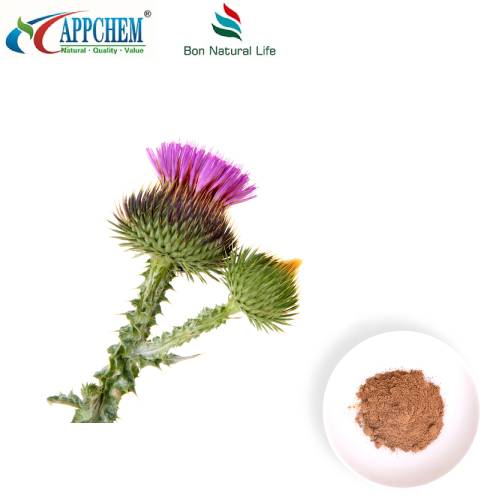
Milk thistle, scientifically known as Silybum Marianum, is a plant native to Mediterranean regions that has been used for medicinal purposes for over 2000 years. Milk thistle extract is derived from the seeds of the plant and has been identified as one of the most potent natural liver detoxifiers. It contains a complex of bioactive components, the most important of which is silymarin, a group of flavonoids shown to have antioxidant and anti-inflammatory effects.
1. What is Milk Thistle Extract?
Milk thistle is an annual or biennial herbaceous plant of the Asteraceae family, belonging to the genus Silybum. Its plants are tall and can reach 1-2 meters, with wide leaves and sharp edges. The leaves have unique white markings, said to be caused by milk dripping from the Virgin Mary. Therefore, it is named "Milk Thistle" or "St. Mary's Thistle" in the West.[1] This plant is native to the Mediterranean coast of Europe, as well as North Africa and the Middle East. It has now been widely introduced and naturalized in temperate regions around the world.
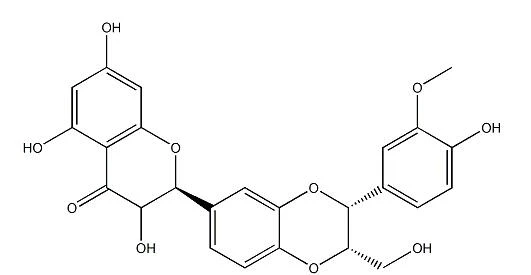
The medicinal value of milk thistle mainly lies in its mature fruit and seeds. These parts are rich in a complex flavonoid lignan called "Silymarin". Silymarin is not a single compound, but a mixture of active ingredients, mainly composed of four isomers: Silybin or Silibinin, Isosilybin, Silychristin, and Silydianin. Among them, silibinin is the core component with the highest content (about 50% -70%) and the strongest biological activity, and is the main contributor to the vast majority of pharmacological effects
| Specification: |
| ●Milk Thistle Extract: UV 80% HPLC30%-60% |
| ●Silybin: HPLC 80%-98% (Extraction solution: acetone, ethyl acetate, ethanol) |
| ●Silymarin: UV 80% HPLC 50-65% |
| ●Water Soluble Silymarin: HPLC 20%-35% UV40%-50% |
|
Structural formula:
|
2. Certificate Of Analysis (COA)
|
Product Name |
Milk Thistle Extract |
Botanical Source |
Silybum marianum L. |
|
CAS No. |
N/A |
Plant Part |
Seed |
|
ITEM |
SPECIFICATION |
RESULT |
TEST METHOD |
|
Physical Description |
|||
|
Appearance |
Yellow to Brown Powder |
Conforms |
Visual |
|
Odor |
Characteristic |
Conforms |
Organoleptic |
|
Taste |
Characteristic |
Conforms |
Olfactory |
|
Particle size |
NLT 98% through 80 mesh |
Conforms |
CP2020 |
|
Identification |
|||
|
TLC test |
The fingerprint should comply with the standard chromatogram |
Conforms |
TLC |
|
Chemical Tests |
|||
|
Silymarin |
≥80.0% |
80.25% |
UV |
|
Loss on drying |
≤5.0% |
3.26% |
CP2020 (105 oC, 3 h) |
|
Ash |
≤1.0% |
0.35% |
CP2020 (600 oC, 4 h) |
|
Solvent Residue(Acetone) |
≤3,000 ppm |
Conforms |
USP467(GC) |
|
Solvent Residue(Hexane) |
≤290 ppm |
Conforms |
USP467(GC) |
|
Solvent Residue(Ethanol) |
≤5,000 ppm |
Conforms |
USP467(GC) |
|
Heavy Metals |
≤20 ppm |
Conforms |
CP2020 |
|
Lead (Pb) |
≤1ppm |
Conforms |
CP2020(AAS) |
|
Arsenic (As) |
≤0.5ppm |
Conforms |
CP2020(AAS) |
|
Cadmium (Cd) |
≤0.5 ppm |
Conforms |
CP2020(AAS) |
|
Mercury (Hg) |
≤0.5 ppm |
Conforms |
CP2020(AAS) |
|
Microbiology Control |
|||
|
Aerobic bacterial count |
≤1,000 cfu/g |
Conforms |
CP2020 |
|
Total Yeast & Mold |
≤100 cfu/g |
Conforms |
CP2020 |
|
Escherichia coli |
Negative |
Conforms |
CP2020 |
|
Salmonella |
Negative |
Conforms |
CP2020 |
|
Conclusion |
Conforms to specification |
||
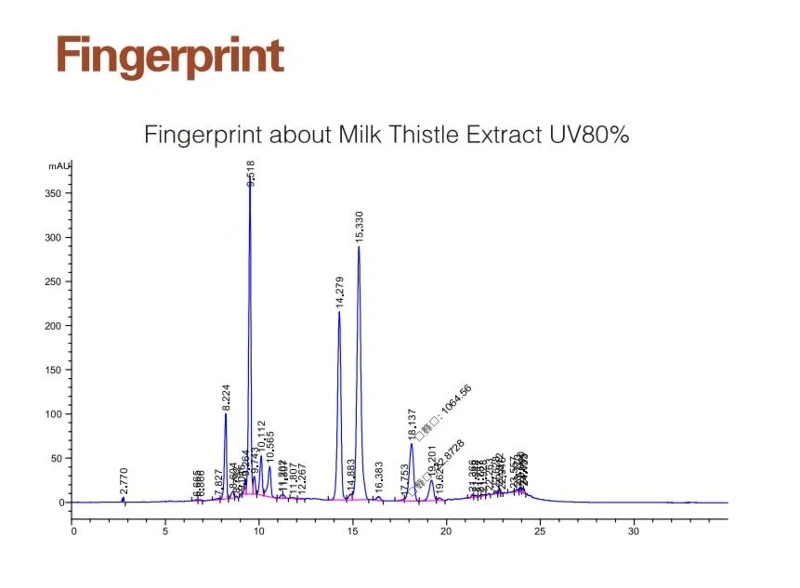
3. Fingerprint of Milk Thistle Extract
4. Is Milk Thistle Extract Effective? How Does It Work?
The health benefits of milk thistle extract have been widely scientifically validated, especially in the field of liver health. Its efficacy is mainly attributed to the various biological activities of the core ingredient silymarin. The following will elaborate on its main efficacy and mechanism of action based on cutting-edge research in the past three years.
- Antioxidant effect: The liver is the main metabolic organ in the human body, and a large amount of free radicals are produced during the metabolic process. Excessive free radicals can attack cell membranes, leading to lipid peroxidation and ultimately damaging liver cells. The phenolic hydroxyl group in the molecular structure of silymarin makes it a powerful free radical scavenger and antioxidant.[5] It can directly neutralize reactive oxygen species (ROS) and enhance the body's own antioxidant defense system by increasing the levels of endogenous antioxidants in liver cells.
- Anti-inflammatory effect: Many liver injuries are accompanied by inflammatory reactions. The NF-κB signaling pathway is a key pathway for regulating inflammatory responses. When stimulated by alcohol, drugs, viruses, etc., this pathway is activated, inducing the production of various pro-inflammatory factors. Multiple studies have confirmed that silymarin can effectively inhibit the activation of the NF-κB signaling pathway, thereby alleviating liver inflammation damage.
- Promoting liver cell repair and regeneration: Silymarin can specifically stimulate RNA polymerase I in the nucleus, accelerate the transcription process of ribosomal RNA, and promote protein synthesis. This mechanism contributes to the structural repair and functional recovery of damaged liver cells, accelerating their regeneration.[4]
- Anti-liver fibrosis: Chronic liver injury can lead to activation of hepatic stellate cells (HSCs), excessive production of extracellular matrix such as collagen, and ultimately develop into liver fibrosis or even cirrhosis. Silymarin has been shown to inhibit the activation and proliferation of HSCs, reduce collagen synthesis, and thus delay or reverse the process of liver fibrosis.[6]
Powerful hepatoprotective effect


5. What Are the Applications of Milk Thistle Extract?
- Capsules: This is the most common and convenient form of product, divided into hard capsules and soft capsules.
5.1 Hard capsules: usually filled by mixing milk thistle extract powder with appropriate excipients. A typical hard capsule formula may include: milk thistle extract (standardized to contain 80% silymarin), microcrystalline cellulose (filler/diluent), magnesium stearate (lubricant), silica (anti-caking agent), and capsule shell material is mostly gelatin or plant-based hydroxypropyl methylcellulose (HPMC) to meet the needs of vegetarians.[2]
5.2 Soft capsules: Milk thistle extract is usually dissolved or suspended in an oily matrix (such as soybean oil, sunflower seed oil), and then encapsulated in gelatin. The soft capsule form may help improve the bioavailability of silymarin, a fat-soluble ingredient.
5.3 Compound capsules: To enhance synergistic effects, many products adopt a compound design. For example, combining milk thistle extract with other beneficial liver or antioxidant components, such as Korean thistle extract, dandelion root extract, curcumin, N-acetylcysteine (NAC), or alpha lipoic acid.
5.4 Tablets: Made by mixing milk thistle extract powder with binders, disintegrants, lubricants, and other excipients and pressing them. The surface of the tablet can be coated to mask unpleasant odors, prevent moisture, or achieve specific release effects such as enteric coating.
5.5 Powder: sold in bulk powder or single-dose small bag packaging. Consumers can mix it with water, juice, or smoothies to drink. This form is highly flexible, easy to adjust dosage, and avoids the difficulty of swallowing capsules or tablets.
5.6 Liquids: including tinctures, oral liquids, or drops. The liquid form usually absorbs faster. Tinctures are extracted using alcohol and water as solvents, while non-alcoholic liquid extracts use glycerol or other substances as the matrix.[3]
6. Why Choose APPCHEM?
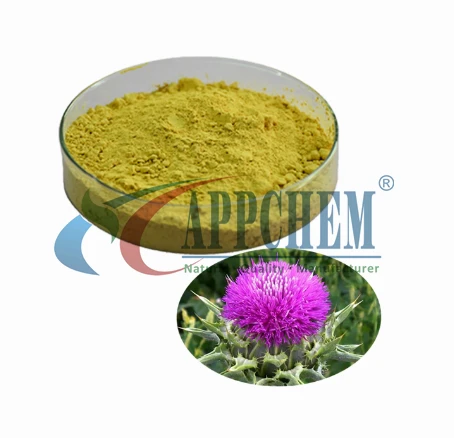
Our Milk Thistle Seed Extract is a high-quality, standardized extract that is produced using a proprietary process. We use state-of-the-art technologies to ensure that our product is of the highest purity and potency. Our extraction process ensures that the active ingredients are preserved, and the final product is free of contaminants. The significant advantage of Milk Thistle Seed Extract is that it has been standardized to contain a minimum of 80% silymarin. This makes it one of the most potent milk thistle extracts available in the market. The high concentration of silymarin ensures that our product is incredibly effective at protecting and detoxifying the liver.
We pride ourselves on offering a reliable, high-quality product that meets international standards. Our factory is ISO 9001 and FDA certified, and we have a quality control team that ensures that every batch of our products meets our stringent quality standards. Our Milk Thistle Seed Extract is a potent, standardized, and reliable product that is ideal for merchants looking to provide their customers with natural liver support. Our proprietary processes ensure that our product is of the highest purity and potency, making it an excellent addition to any product line. Whether you are in the health food industry, supplement manufacturing, or cosmetics, our product is an excellent choice for you.
7. Certificates

Security statement:
Our company guarantees that the goods sent are safe, non-flammable, and non-explosive, and consistent with the declaration. Under normal transportation conditions, all losses caused by the products sent by our company shall be borne by our company.
Tags: Milk Thistle Seed Extract, Silymarin Milk Thistle Extract manufacturers, suppliers, factory, wholesale, best, price, buy, for sale, bulk

Reference
[1] Rapid determination of silymarin in milk thistle using Agilent ZORBAX Eclipse Plus C18 1.8 μ m chromatographic column and Agilent 1290 Infinity liquid chromatography system Nick Severin.
[2]MILK THISTLE HARD CAPSULES Milk Thistle Standardised Fruit Extract. Holland & Barrett Limited.[2021-02-20]
[3]Herbert J. Lilling. "US 6, 238, 696 B 1 3 Example 1 Preparation of Echinacea Supreme: The aqueous alcohol extracts of Echinacea angustifolia root, Echinacea purpurea root, Echinacea purpurea flower, and Echinacea purpurea."[2017]
[4] Research progress on the preventive and therapeutic effects of silymarin on experimental liver disease and its related clinical applications, Zhang Juan and others [2023-10]
[5] Optimization of natural low melting point solvent extraction process for silibinin and exploration based on COSMO-SAC mechanism Yao Jinhao and others [2022-04]
[6] Research on the mechanism of action of Silymarin in treating lung cancer based on systems pharmacology, Zhang Yuru et al. [2022-06]


