

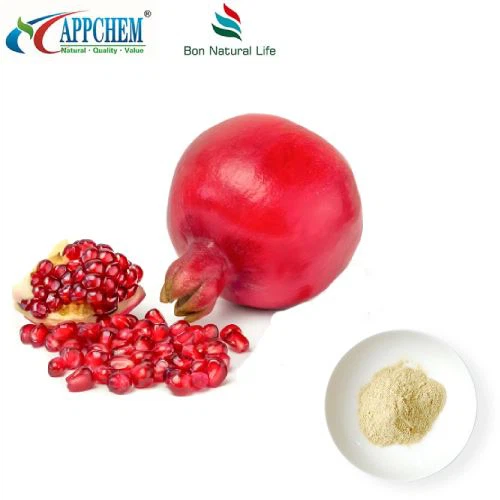
What Is the Pomegranate Peel Extract Powder and Positioning?
Pomegranate Peel Extract Powder is a natural active ingredient complex derived from the dried peel of the pomegranate (Punica granatum L.), obtained through extraction, purification, and drying processes. The core active constituents include ellagic acid, punicalagin, and pomegranate polyphenols. Among these, punicalagin is the most abundant and representative characteristic component in pomegranate peel, belonging to the category of high molecular weight hydrolysed tannins. With its exceptional antioxidant capacity, anti-inflammatory and soothing properties, and multiple physiological activities, pomegranate peel extract holds extensive application value across dietary supplements, functional foods, premium skincare products, oral care formulations, and natural preservatives.
Positioned for the global B2B bulk ingredient market, this product originates from a source manufacturing facility. It is specifically designed to provide plant extract industry purchasers, product R&D teams, production plants, and brand decision-makers with professional-grade raw materials featuring high specifications (ellagic acid 40%-98%, polyphenols 20%-60%), batch consistency, quality control, and supply chain traceability. We offer flexible sample support (minimum sample quantity 50g) with an annual supply capacity exceeding 6,000 tonnes, designed to meet enterprise-level clients' full-process requirements from R&D testing to global-scale mass production.
PS: This page focuses on the Integrated Supply Chain & Solutions.
For the product application information, please click Cosmetic Ingredients Pomegranate Peel Extract Powder.
For the product Technical Data Sheet, please click Pomegranate Peel Extract Powder HPLC Test Data.
What Are the Core Challenges and Scientific Responses in Pomegranate Peel Extract Industrialisation?
As an abundant agricultural by-product, pomegranate peel faces several critical industrial-scale conversion bottlenecks in its transition from traditional utilisation to modern, high-value commercial applications. Deeply understanding and resolving these bottlenecks is fundamental to distinguishing between "primary processed goods" and "high-value commercial application materials" – and lies at the heart of our value proposition as a source manufacturer.
Challenge One: The Deep-Seated Conflict Between High Activity and Sensory Compatibility
Pomegranate peel extract is renowned for its high hydrolysable tannin content, yet this presents two critical sensory compatibility challenges:
- Pronounced astringency (bitterness): Hydrolysed tannins rank among the most potent astringent compounds in the plant kingdom. This astringent sensation arises from tannin binding with oral salivary proteins, presenting a primary sensory barrier when applying pomegranate peel extract to oral products (e.g., functional beverages, oral liquids, chewable tablets).
- Impact of colour on product appearance: Pomegranate peel extract typically presents as a powder ranging from brownish-yellow to reddish-brown. When incorporated into light-coloured systems (e.g., clear beverages, pale creams, gel formulations), it may introduce noticeable colour variation, affecting the visual appeal of the final product.

For B2B clients, this signifies that pomegranate peel extract's "high potency" and "sensory challenges" are two sides of the same coin. An ingredient whose astringency or colour cannot be readily masked may be excluded from market consideration despite its efficacy, particularly within the fast-moving consumer goods sector, where sensory standards are stringent.
Our scientific response and product solutions
- Multi-specification systems and decolourisation treatments: We offer pomegranate peel extracts in varying specifications (polyphenol content 20%-60%) and degrees of decolourisation to meet requirements for transparent, semi-transparent, and dark-coloured formulations. For colour-sensitive recipes, we recommend specially processed light-coloured variants.
- Flavour Synergy and Masking Application Data: Drawing upon our application laboratory's accumulated expertise, we provide clients with synergistic formulation references for pomegranate peel extract alongside natural sweeteners (such as stevioside, NHDC), acidity regulators, and other flavour compounds. Of particular note, NHDC (neohesperidin dihydrochalcone) effectively elevates the human perception threshold for bitterness at sub-sweetness threshold concentrations (approximately 5-20 ppm), making it an ideal flavour-modifying partner for pomegranate peel extract formulations.
- Flavour Masking Consultancy: For applications with exceptionally stringent sensory requirements (e.g., children's functional foods, oral care products), we recommend flavour masking solutions such as microencapsulation and molecular inclusion, with support for pilot-scale validation trials.
Challenge Two: Establishing the Scientific Evidence Chain for In Vivo Efficacy Translation
Extensive in vitro studies and select animal experiments have demonstrated the potential of pomegranate peel extract and its core components (punicalagin, ellagic acid) in antioxidant, anti-inflammatory, cardiovascular protection, and skin protection. However, a common misconception in industrial translation is equating "in vitro activity data" directly with "in vivo effective dosage". As a high-molecular-weight tannin, punicalagin exhibits relatively low in vivo bioavailability. Yet, under the action of gut microbiota, it hydrolyses and converts into more readily absorbed active metabolites such as urolithins, thereby exerting sustained physiological effects.
For B2B clients, this implies that efficacy validation of pomegranate peel extracts must extend beyond raw material-level antioxidant activity testing. A commercially viable pomegranate peel project requires end-to-end validation across the entire chain: "raw material composition profile → in vivo metabolic pathways → target action mechanisms → consumer-perceivable benefits".

Our scientific response and product solutions
- Batch Consistency and Traceability: We guarantee high inter-batch consistency in the ingredient profile, impurity profile, and key activity indicators of our raw materials. This forms the foundation for generating reproducible data in any subsequent in vivo or in vitro efficacy studies.
- Support for Efficacy Validation and Claims: Our analytical certificates include detailed testing data, providing reliable raw material assurance for clients conducting in vivo efficacy validation experiments and helping them build a chain of evidence for product efficacy. Upon request, we furnish foundational research literature on raw materials to support scientific claims.
- Commercial Viability through Bulk Supply Capacity: Any exceptional formulation validated through extensive R&D must rely on long-term, stable, and scalable raw material supply. Our factory-direct model ensures a seamless transition from successful development to mass production and market launch.
How Does the Cooperation Process Work?
To meet the stability requirements of international raw material procurement projects, we have established a scalable cooperation process system enabling clients to transition progressively from technical evaluation to long-term supply partnerships.
1) Requirement Confirmation and Technical Communication
At the initial cooperation stage, both parties first confirm:
- Extraction ratio or active ingredient content
- Target application field (food / dietary supplements/cosmetics)
- Procurement scale and supply cycle
- Packaging specifications and logistics requirements
This step ensures product specifications align with the client's formulation system.
2) Sample Validation and Batch Assessment
For first-time clients, the following are typically conducted:
- Sample testing
- Active ingredient content analysis
- Formulation stability evaluation
Sample batch data serves as the reference benchmark for future production batches.
3) Supply Planning and Capacity Arrangements
Upon confirming cooperation intent, a supply plan is formulated, including:
- Annual procurement volume
- Production scheduling
- Delivery lead times
- Safety stock arrangements
This planning ensures a stable raw material supply for clients amid fluctuating market demands.
4) Mass Production and Delivery
The mass production phase encompasses:
- Raw material screening
- Standardised extraction processes
- Batch quality control
- Packaging and international shipping arrangements
All production batches are accompanied by comprehensive testing reports.
Our Service Processes
Our free service hotline:88346301
Pre-sales Consultancy
1
>>
Confirmation of order
2
>>
Production
3
>>
Multi-Channel Shipping
4
>>
Confirmation of receipt
5
>>
After-sale Services
6
Sample Service Policy
| Item | Details |
| Minimum Sample Quantity | From 50g (100g or 500g specifications available upon request) |
| Sample Fee | Complimentary samples for new clients during the R&D phase (shipping costs borne by the recipient) |
| Sample Delivery Time | Stock samples dispatched within 3-5 working days |
| Accompanying Documentation | Certificate of Analysis (COA) for corresponding batch (including HPLC/UV test data), Material Safety Data Sheet (MSDS) ... |
| Sample Application Support | Support for content verification, solubility testing, formulation pre-research, stability assessment, and sensory evaluation |
How Does the International Logistics System Operate?
Plant extract raw materials typically involve cross-border trade, rendering the logistics system pivotal within the supply chain. For bulk supplies of Pomegranate Peel Extract Powder, international transportation must account not only for transit times but also for customs clearance efficiency, transport stability, and product storage conditions.

Trade terms: International raw material transactions typically employ standard international trade terms such as FOB, CIF, CFR, DAP, or DDP. Different trade terms suit varying procurement models. For instance, large-scale raw material purchasers may favour FOB or CIF arrangements, while small and medium-sized enterprises might opt for DAP or DDP to reduce operational complexity in import procedures.
Transportation methods: Transportation methods are primarily divided into sea freight and air freight. For tonnage-level raw material orders, sea freight is typically the most common method due to its lower transport costs and suitability for bulk cargo. Sea freight transit times generally span several weeks, necessitating planning for production and shipment schedules. In contrast, air freight is more suitable for samples, urgent replenishments, or high-value raw materials, though costs are typically higher.
Preparation of customs clearance documentation: Common documentation includes Certificates of Analysis (COA), Safety Data Sheets (SDS), product specification sheets, and Certificates of Origin. These documents facilitate importers' successful completion of customs declarations and product regulatory compliance processes.
Furthermore, logistics systems must occasionally account for risk factors such as transport insurance, cargo tracking, and port congestion. Through prudent logistics planning and risk management, the stability of cross-border supply chains can be significantly enhanced.
What Does the Industrial Packaging System Include?
Plant extract powders are susceptible to humidity, oxygen and light exposure during long-distance transport and storage, making the industrial packaging system crucial for product stability.
APPCHEM's standard packaging structure generally comprises two tiers: inner and outer packaging.
- Inner packaging commonly employs food-grade aluminium foil pouches or PE inner bags, materials offering superior moisture and oxidation resistance to minimise air and humidity impact.
- Outer packaging typically utilises cardboard drums or fibre drums, providing adequate crush resistance suitable for international shipping and storage.

Within international raw material trade, 25kg/drum represents a prevalent standard packaging specification. This specification facilitates both manual handling and palletised transport or container loading. For larger clients, bespoke packaging solutions can be provided upon request, such as larger-capacity containers or palletised shipping arrangements. Given the significant temperature and humidity fluctuations inherent in maritime transport, our packaging design incorporates moisture-proofing measures. This includes incorporating desiccants within the inner packaging or employing sealed structures to minimise the risk of product dampness during transit.
FAQ
Q1: What are the core active components in pomegranate peel extract? How do they relate to one another?
A1: The core active components in pomegranate peel extract primarily comprise three major categories: punicalagin, ellagic acid, and total polyphenols. Punicalagin is the most abundant macromolecular hydrolysable tannin in pomegranate peel, exhibiting potent antioxidant activity. Ellagic acid is a small-molecule polyphenol that can be hydrolysed from punicalagin and also serves as a key indicator of antioxidant capacity. When selecting raw materials, attention should be paid to the complete spectrum of these components rather than isolated metrics.
Q2: What is the solubility of pomegranate peel extract?
A2: Pomegranate peel extract is soluble in water and ethanol-water solutions, with a solubility in pure water of approximately 5-10 g/L (25°C).
Q3: What is the minimum order quantity (MOQ)?
A3: The MOQ for standard products is 25 kilograms, while the MOQ for sample orders is 50 grams. For new clients or R&D phases, we encourage initial validation through sample testing.
Q4: What is the delivery lead time?
A4: Stock orders are dispatched within 3-7 days. Customised or bulk orders require 4-6 weeks post-contract confirmation, subject to order volume, specifications, and destination.
Q5: Is pomegranate peel extract suitable for "clean label" or natural claims?
A5: Yes. Pomegranate peel extract is derived from natural pomegranate rind, extracted using water and/or ethanol. The production process involves no synthetic solvent residues, meeting clean label and natural claim requirements. Our products hold KOSHER, HALAL, and NON-GMO certifications, supporting clients' natural positioning.
Exploring Synergistic Ingredients and Product Matrix
Pomegranate peel extract stands as a cornerstone ingredient within our botanical extract portfolio. To empower your development of more innovative and competitive end products, we recommend concurrently considering the following synergistic or complementary offerings:
| Product Category | Key Ingredient | Primary Application |
| Ellagic Acid | HPLC 40%-90% | High-purity brightening and antioxidant raw material, suitable for functional skincare products |
| Punicalagin | HPLC 20%-60% | Highly antioxidant active ingredient, suitable for dietary supplements |
| NHDC | HPLC 98% | Bitter taste masking and sweetness modification; synergises with pomegranate peel extract to enhance palatability |
| Green Tea Extract | EGCG 50%-98% | Synergistic antioxidant and anti-inflammatory properties for developing comprehensive skincare formulations |
Click here to access our full botanical extract product catalogue for further specialised ingredient solutions.
Reference
[1] Akhtar, S., Ismail, T., Fraternale, D., & Sestili, P. (2015). Pomegranate peel and peel extracts: Chemistry and food features. Food Chemistry, 174, 417-425.
[2]Aviram, M. et al. (2000). Pomegranate juice consumption reduces oxidative stress. American Journal of Clinical Nutrition. https://doi.org/10.1093/ajcn/71.5.1062
[3]Viuda-Martos, M., et al. (2010). Pomegranate and its many functional components as related to human health. Comprehensive Reviews in Food Science and Food Safety.
https://doi.org/10.1111/j.1541-4337.2010.00131.x
[4]Fischer, U. A., et al. (2011). Determination of antioxidant capacity and phenolic compounds in pomegranate peel. Journal of Agricultural and Food Chemistry. https://doi.org/10.1021/jf104144c
[5]National Centre for Biotechnology Information (NCBI). Pomegranate polyphenols and antioxidant activity. https://www.ncbi.nlm.nih.gov/pmc/articles/PMC4586562/


