

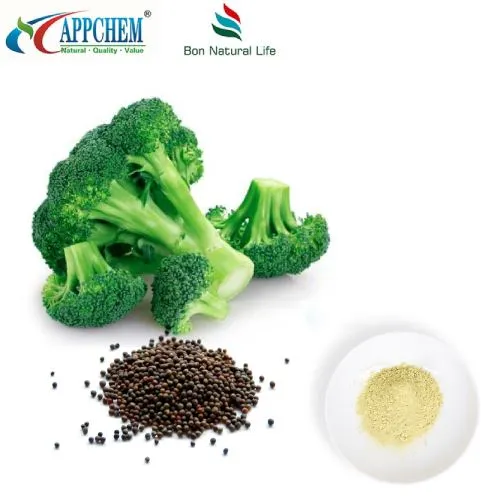
What is Broccoli Extract Powder Sulforaphane?
Sulforaphane is a natural isothiocyanate compound found widely in cruciferous vegetables such as broccoli, kale, and cabbage. It is not a naturally free-standing component in broccoli, but rather an active metabolite generated by the hydrolysis of its precursor, glucoraphanin, by endogenous myrosinase when plant tissue is disrupted. Many 'broccoli extract' products on the market merely state the total glucosinolate content or utilise sulforaphane raw materials with poor stability. This results in significant variations in activity between batches and makes it difficult to guarantee efficacy, posing significant challenges for B2B clients in terms of formulation consistency, efficacy validation, and international compliance.
To address this, APPCHEM is launching this 5% sulforaphane powder (CAS: 21414-41-5), rigorously quantified via HPLC. It is not merely a raw material, but a standardised Nrf2 activator solution designed for procurement managers, product development engineers, and quality decision-makers in the plant extract industry. This product strictly adheres to leading international pharmacopoeias and the ISO quality management system, with its core value lying in precise control of precursor conversion, HPLC quantitative analysis, stable active ingredients, and full traceability throughout the production process.
PS: This page focuses on the product Technical Data Sheet.
For the product application information, please click Functional Food Ingredient Sulforaphane Powder SFN.
For Integrated Supply Chain & Solutions, please click Broccoli Extract Powder Sulforaphane Bulk Supply.
What Are the Key Numerical Data for Ingredients?
Physical and Chemical Properties
| Common Name | Sulforaphane |
| Synonyms | Broccoli sulphane; 1-Isothiocyanato-4-methylsulphonylbutane |
| CAS Number | 142825-10-3 (Broccoli sulphane monomer) |
| Molecular Formula |
C6H11NOS2
|
| Molecular Weight | 177.3 g/mol |
| EINECS | 244-374-7 |
| Density | 1.4±0.1 g/cm³ (25°C) |
| PSA | 236.07000 |
| LogP | -0.53 |
| Appearance and Characteristics | This product is a fine, uniform powder ranging in colour from pale yellow to light brown, with a characteristic odour. |
| Solubility | The sulforaphane monomer is a volatile, oily liquid; after stabilisation, it forms a powder. It is soluble in organic solvents such as methanol, ethanol and DMSO, and slightly soluble in water. |
| Stability | Sulforaphane is sensitive to light and heat, and is prone to volatilisation, oxidation and decomposition. This product utilises microencapsulation/encapsulation technology to enhance stability. It is recommended to store the product in a sealed container at -10 to -20°C, refrigerated, in a light-protected environment. Use as soon as possible after opening. Under these conditions, the product has a shelf life of 24 months. |

Safety and Compliance Criteria
This product's safety standards comprehensively reference regulatory requirements from major markets, including China, the European Union, and the United States. Both internal and third-party laboratories have validated all data.
| Heavy Metal Limits |
Complies with the 2020 edition of the Chinese Pharmacopoeia and internationally recognised standards: Heavy Metal ≤ 10 mg/kg Lead (Pb) ≤ 1 mg/kg Arsenic (As) ≤ 2 mg/kg Cadmium (Cd) ≤ 0.5 mg/kg Mercury (Hg) ≤ 0.5 mg/kg |
| Pesticide Residues | Screening employs GC-MS/MS and LC-MS/MS methods to ensure no detection or levels below the limit of quantification for over 200 common pesticides. |
| Microbial Control |
Total Aerobic Bacteria ≤ 1,000 CFU/g Total mould and yeast count ≤ 100 CFU/g Not detectable: Escherichia coli, Salmonella spp., Staphylococcus aureus |
| Non-GMO and Non-Irradiated Declaration | The raw materials for this product are sourced from non-GMO broccoli. No genetically modified techniques or irradiation sterilisation have been used at any stage of the production and processing process, and a written declaration to this effect is provided. The product complies with Kosher and Halal certification requirements. |
TDS Guide
Sulforaphane is the active metabolite produced by the enzymatic conversion of sulforaphane glucoside; its content is closely linked to raw material selection, extraction processes and conversion efficiency. A professional Technical Data Sheet (TDS) not only specifies the HPLC-determined content but also explains the scientific rationale behind different specifications.
- Standard Specification: HPLC 5% sulforaphane. This is a common industrial specification in the dietary supplement and functional food sectors, striking a good balance between bioactivity, application cost and formulation compatibility.
- The Relationship Between Precursors and Active Compounds: Glucoraphanin is a stable precursor of sulforaphane, found in broccoli seeds and sprouts. When plant tissue is broken down, glucoraphanin comes into contact with myrosinase, which hydrolyses it to produce the active compound sulforaphane. Sulforaphane itself is unstable, whereas glucoraphanin is a stable solid that is easy to store and process.
| Specification | Typical Content | Cost Implications | Efficacy & Application Differences |
| Standard Grade | 1% - 5% | Economical | Suitable for cost-sensitive foundational products with broad efficacy targeting; formulation loading capacity must be adequately reserved. |
| High-Purity Grade | 6% - 25% | Optimal cost-effectiveness | Defined active components with precisely calculable dosages, ideal for targeted efficacy claims in premium skincare and functional foods |
| Reference Grade | >30% | High cost | Primarily for laboratory analytical comparison; not recommended for large-scale commercial production. |
|
Key Consideration: Selecting different purity grades primarily balances cost, efficacy intensity, and formulation precision. Regardless of your specification, you receive our consistent assurance regarding raw material sourcing, safety testing, and quality control systems. 1. Consistent raw material sourcing: All sourced from non-GMO, standardised cultivation bases. 2. Consistent testing standards: Adherence to equally stringent pesticide residue and heavy metal safety testing protocols. 3. Unified quality control: Manufactured under the same ISO-certified end-to-end quality management system. |
|||
Key Notes: The choice of product specification primarily involves striking a balance between the active form, cost and formulation objectives. Whichever specification you choose, you will benefit from our consistent and reliable assurance regarding raw material sourcing, safety testing and quality control systems.
Certificate of Analysis (COA)
APPCHEM undertakes to provide a Certificate of Analysis (COA) compliant with international standards with every batch of product. The development and validation of the testing methods for this product have been carried out in accordance with authoritative standards such as the United States Pharmacopoeia (USP), the European Pharmacopoeia (EP) and the Chinese Pharmacopoeia (CP), to ensure global compliance of the data. Furthermore, every test result on the COA is traceable to the original records and is available for audit and verification by clients or third parties.
In-depth Quality Control: Analysis of Precursor Residues and Degradation Products
In addition to the quantification of the main sulforaphane peak, we also monitor the residues of sulforaphane precursors and degradation products in the product to ensure its stability throughout its shelf life.

Important Note: The COA information provided on this page is for illustrative purposes only, intended to demonstrate the scope and capabilities of our quality control processes. Sulforaphane is sensitive to light and heat; therefore, sample handling must be carried out in the dark and at low temperatures. For the specific COA document of the actual product (including the precise batch number, HPLC test data and chromatograms), please refer to the final version issued by our sales representative.
Advanced Extraction and Stabilisation Process
APPCHEM utilises a proprietary, environmentally friendly production process to efficiently extract, convert and stabilise sulforaphane from broccoli seeds, sprouts or processing by-products. The diagram below illustrates the key process flow from raw materials to finished product.

Innovative Raw Material Source: Water extracts from broccoli seeds were approved as a new food resource in China in 2017, with a recommended daily intake of ≤1.8 g. The US FDA has also granted GRAS (Generally Recognised as Safe) status, approving its use as a food additive.
Further Information: The flowchart above illustrates the main stages of the process. For more detailed production information, including specific process parameters, patent details and production capacity, please contact our sales representatives. We will be happy to provide further technical consultation tailored to your specific requirements.
End-to-End Quality Management Ecosystem
The quality management system we have established is a closed-loop ecosystem covering the entire lifecycle from cultivation and production through to testing and release. At its core lies the principle of 'prevention first, full process control, and data traceability'.
Source Control (Upstream)
- Germplasm Resources: The breeding of broccoli germplasm has been included in the key R&D projects of the National Major Vegetable Industry Technology System. We collaborate with standardised cultivation bases to ensure the purity of raw material germplasm and the controllability of pesticide residues.
- Raw Material Grading: Depending on the product positioning, we select seeds, sprouts or processing by-products as raw materials. Seeds have the highest sulforaphane content and are suitable for high-value-added products.
- Dual Verification of Raw Material Incoming: Each batch of raw material must be accompanied by a certificate of origin. Upon arrival at the factory, the produce first undergoes a rapid QC check (initial screening for moisture content and glucosinolates). If it passes this stage, it is transferred to the holding store, where it undergoes comprehensive screening for pesticide residues and heavy metals to ensure that only high-quality raw materials are used in production.
Production Process Control (Midstream)
HACCP-based Critical Control Point Management: Multiple Critical Control Points (CCPs) are established along the entire production line. For example, online monitoring is conducted during the enzymatic hydrolysis (CCP1), column chromatography purification (CCP2) and stabilisation (CCP3) processes to ensure that operations remain within the pre-validated 'design space'.
Laboratory Quality Assurance (Downstream)
Release Testing and Stability Studies: Every batch of finished product must pass comprehensive testing covering all physicochemical and safety parameters. We possess advanced analytical equipment, including HPLC, GC-MS and ICP-MS, to test multiple quality parameters such as sulforaphane content, related substances, moisture, heavy metals and microbiological counts.
Stability Studies: Long-term and accelerated stability tests are conducted in accordance with Corporate Internal Quality Control Standards, with a focus on monitoring changes in sulforaphane content during storage to scientifically determine the shelf life.
Certifications & Support Documents
Our transparent quality commitment and R&D capabilities are underpinned by the following authoritative certifications, patented technologies, and supporting documentation.

System Certification Certificates:
- ISO 22000 Food Safety System Certification
- ISO 9001 Quality Management System Certification
Key Supporting Documentation:
- FDA, KOSHER, HALAL, SC...
- Full-project Quality Inspection Reports (batch-specific)
- Material Safety Data Sheet (MSDS)
- Factory Audit Report Summary
We fully recognise the importance of reviewing original documentation during supplier selection. Should you require access to originals or certified copies of the aforementioned certificates, patent documentation, or batch-specific supporting files for formal supplier evaluation or reference purposes, please contact our dedicated manager. We shall provide full cooperation in supplying the required materials to support your decision-making process.
Functional Applications and Customised Formulation Support
Based on a well-defined Nrf2 activation mechanism and extensive clinical research data, sulforaphane is an ideal ingredient for developing multi-target functional products.
Overview of core functional applications:
- Nrf2 pathway activation and cellular protection
- Sports performance and recovery
- Blood Sugar Management
- Cancer Risk Reduction
- Neuroprotection
Recommended Combination Formulations:
- Sports Nutrition Formula: Sulforaphane + BCAAs/Glutamine + Curcumin.
- Blood Sugar Management Formula: Sulforaphane + Chromium/Cinnamon Extract/Mulberry Leaf Extract.
- Immune Support Formula: Sulforaphane + Ganoderma Polysaccharides/Cordyceps Polysaccharides/Chitosan.
- Antioxidant and Anti-Ageing Protocol: Sulforaphane + Resveratrol/Quercetin/Green Tea Extract.
Usage Recommendations:
The efficacy of sulforaphane is closely linked to individual gut microbiota; individuals with abundant beneficial bacteria may experience more pronounced effects. Those with weak spleen and stomach function or prone to bloating may experience increased discomfort with high intake; individuals with thyroid dysfunction should use it with caution. The recommended daily intake may be based on the safety limit for broccoli seed water extracts (≤1.8 g/day).
Customised Solutions:
We have a dedicated R&D team that can provide tailored technical support-from formulation recommendations and stability studies to sample production-based on your specific product concepts (e.g. energy drinks for endurance athletes, diabetes-friendly nutritional powders, or immune-supporting multi-ingredient supplements).
Contact us: To request a Certificate of Analysis (COA), Technical Data Sheet (TDS), HPLC test data, samples, or to discuss customisation requirements for a specific batch, please feel free to contact our technical sales team. We provide free samples for testing; please contact us to arrange delivery before placing an order.
Reference
1. Zhao X, Wen L, Dong M, Lu X. Sulforaphane activates the cerebral vascular Nrf2-ARE pathway and suppresses inflammation to attenuate cerebral vasospasm in rats with subarachnoid haemorrhage. Brain Res. 2016 Dec 15;1653:1-7.
2. Ali-Wali NA, Al-Saidi SJ, Al-Rikabi AK. Sulforaphane inhibits the NF-κB signalling pathway and reduces inflammatory cytokines in experimental models. Int J Mol Sci. 2022;23(19):11245. doi: 10.3390/ijms231911245.
3. Dwibedi C, Sjöberg A, Bäckhed F, Rosengren A, et al. Effect of broccoli sprout extract and baseline gut microbiota on fasting blood glucose in prediabetes: a randomised, placebo-controlled trial. Nat Microbiol. 2025 Mar;10(3):681-693. Doi: 10.1038/s41564-025-01932-w.
4. Egner PA, Chen JG, Wang JB, et al. Rapid and sustainable detoxication of airborne pollutants by broccoli sprout beverage: results of a randomised clinical trial in China. Cancer Prevention Research (Phila). 2014;7(8):813–823. Available from: PMC4125483.
5. Mirmiran P, Bahadoran Z, Hosseinpanah F, et al. Effects of broccoli sprout with high sulforaphane concentration on inflammatory markers in type 2 diabetic patients: a randomised double-blind placebo-controlled clinical trial. Phytother Res / (trial indexed). 2012.
6. Bahadoran Z, Mirmiran P, Hosseinpanah F, et al. Effect of broccoli sprouts on insulin resistance in type 2 diabetic patients: a randomised double-blind clinical trial. International Journal of Food Sciences and Nutrition. 2012;63(7):767–771.
7. Dwibedi C, Axelsson AS, Abrahamsson B, et al. Effect of broccoli sprout extract and baseline gut microbiota on fasting blood glucose in prediabetes: a randomised, placebo-controlled trial. Nature Microbiology. 2025;10(3):681–693. doi:10.1038/s41564-025-01932-w.


