

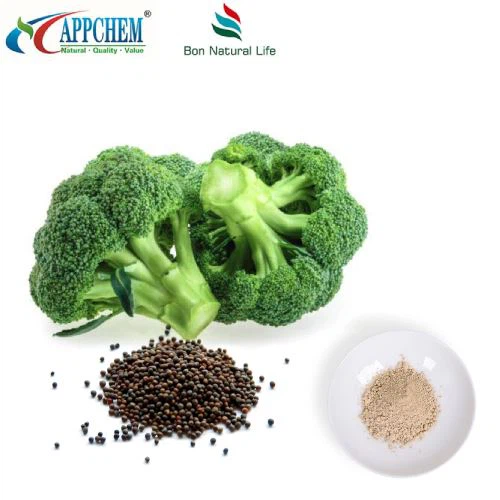
What Is the Broccoli Extract Glucoraphanin Powder?
Broccoli Extract Glucoraphanin Powder is a natural glucosinolate compound extracted and purified from the seeds of the cruciferous vegetable broccoli (Brassica oleracea L. var. italica). Owing to its unique advantage as a stable precursor to sulforaphane, as well as its potential health benefits in areas such as anti-cancer, antioxidant, and anti-inflammatory properties, glucoraphanin holds broad application prospects in dietary supplements, functional foods, pharmaceutical intermediates, and high-end skincare products.
This product is positioned for the global B2B bulk raw material supply market. As a source manufacturer, we specialise in providing professional-grade raw materials of high purity (HPLC 1%–20%, customisable up to 98%), batch consistency, controlled quality and supply chain traceability to buyers in the plant extract industry, product R&D teams, manufacturing plants and brand decision-makers. We hold international certifications, including ISO 9001, ISO 22000, Kosher, and Halal, with an annual supply capacity exceeding 10,000 tonnes. We offer flexible sample support (minimum sample quantities starting from 10–25g), aiming to meet the end-to-end requirements of enterprise-level clients, from R&D testing to large-scale global production.
What Are the Core Challenges and Scientific Solutions for Glucoraphanin Industrialisation?
As a characteristic precursor compound in broccoli extracts, glucoraphanin faces several critical bottlenecks in its transition from laboratory research to large-scale commercial application.
Challenge 1: The Dual Hurdles of Precursor Stability and Active Conversion
As a stable precursor to sulforaphane, glucoraphanin possesses good chemical stability; however, this very characteristic introduces complexities regarding its conversion to an active form:
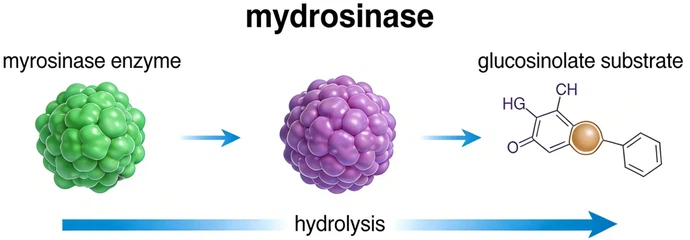
- The Necessity and Uncertainty of Enzymatic Conversion: Glucoraphanin is a relatively inert glucosinolate that requires hydrolysis by myrosinase to be converted into the biologically active compound sulforaphane. This conversion process faces multiple uncertainties in commercial applications: the activity of endogenous myrosinase in the raw material may be inactivated by processing methods (such as heating and drying); whilst the human gut microbiota possesses a certain capacity for conversion, there are significant individual variations.
- Impact of thermal processing on conversion efficiency: Studies indicate that heating broccoli at 70°C for 10 minutes reduces its glucoraphaninase activity by 95%. This implies that broccoli extracts processed via conventional drying methods may have severely compromised endogenous enzyme activity unless special protective measures are taken, resulting in consumers being unable to effectively convert glucoraphanin into active sulforaphane following ingestion.
- The relationship between in vitro conversion and in vivo absorption: Even when exogenous myrosinase is supplemented, or probiotics are used to promote intestinal conversion, the bioavailability of glucoraphanin still exhibits significant inter-individual variation. Research indicates that supplementing with probiotics such as Lactobacillus plantarum, which possess myrosinase activity, may enhance the bioavailability of sulforaphane, but the effect varies from person to person.
For B2B clients, this implies that when procuring glucoraphanin, a supplier's control over raw material processing, measures to preserve enzyme activity, and validation data regarding the product's convertibility are more critical decision-making factors than mere purity figures. A product that merely offers a high-purity precursor, yet fails to guarantee effective conversion within the end consumer's body, will see its commercial value significantly diminished.
Our scientific response and product solutions:
As a source manufacturer, we have established a comprehensive technical control system covering the entire supply chain from raw materials to finished products:
- Gentle processing methods: We employ low-temperature drying technology (<40°C) and short-duration extraction processes to maximise the retention of endogenous myrosinase activity in the raw materials, thereby providing the enzymatic foundation for subsequent conversion.
- Specification Grading and Conversion Validation: We offer products in a range of concentrations from 1% to 20%, and provide 'in vitro enzymatic conversion rate' test data for batch products upon customer request, ensuring the convertibility of the precursor substance is verified.
- Formulation Support: For applications requiring guaranteed in vivo conversion efficiency, we can recommend formulation solutions that combine the product with stabilised black mustard enzyme preparations or specific probiotics (such as Lactobacillus plantarum).
Challenge 2: Inter-individual Variability in Bioavailability and Efficacy Validation
The bioactivity of glucoraphanin depends on the efficiency of its conversion within the body, a process influenced by multiple factors:
- Inter-individual variability in gut microbiota: There is significant inter-individual variation in the abundance of bacteria with glucoraphaninase activity (such as Lactobacillus plantarum) in the human gut, which directly affects the efficiency of glucoraphanin's conversion to sulforaphane.
- The influence of diet and co-ingested components: Certain food components may promote or inhibit the activity of gut microbiota, thereby affecting the conversion rate of glucoraphanin.
- Room for optimisation in formulation design: Studies show that when glucoraphanin is co-administered with active myrosinase, the bioavailability of sulforaphane can be increased by 3–4 times.
For B2B clients, this implies that the efficacy validation of glucoraphanin products must not be limited to the 'precursor content' alone; it must also take into account the target population's conversion capacity, the optimisation of formulation design, and the dose of the active form reaching the target organ.

Our scientific response and product solutions:
- Bioavailability research support: We can provide clients with literature on the bioavailability of glucoraphanin and its metabolite sulforaphane, including reference data on optimisation strategies such as co-delivery with black mustard seed enzyme and combination with probiotics.
- Formulation Development Technical Support: Our technical team can provide recommendations on the formulation of black mustard enzyme, probiotics, or other excipients tailored to different application scenarios, assisting clients in developing end products with stable conversion efficiency.
- Batch Consistency and Traceability: We guarantee high consistency between batches in terms of the raw material's compositional profile, impurity profile, and key activity indicators, providing a reproducible raw material foundation for any subsequent in vivo and in vitro efficacy studies.
What Are the Core Strengths and Quality Assurance System?
As a source manufacturer, we have established a comprehensive quality assurance system and the capacity for immediate supply.
Core Strengths of the Factory
1. Production and Quality Control: We have specialised in the research, development and production of plant extracts for over 20 years, operating an integrated production base that encompasses collaborative broccoli breeding and cultivation facilities alongside modern extraction and purification processes. With an annual production capacity exceeding 10,000 tonnes, we are able to meet the diverse needs of global clients, ranging from small-scale R&D to large-scale mass production.
2. International Certifications: Our production facility strictly adheres to the ISO 9001 Quality Management System and ISO 22000 Food Safety Management System, with key production processes compliant with cGMP guidelines. We also hold multiple internationally recognised certifications, including HALAL, KOSHER and NON-GMO.

3. Supply System:
Standard Stock: Ton-level stock is maintained for common specifications such as 1%, 5%, 10% and 20%.
Sample Support: Available from 10–25g; free samples are provided to new customers during the R&D phase (international shipping costs apply).
Delivery Times: Stock orders dispatched within 3–7 working days; customised orders within 2–4 weeks
4. Technical Services: We are equipped with an application laboratory and a team of experienced technical consultants, enabling us to provide targeted application advice, specification recommendations and stability testing support to clients during the early stages of formulation development.
| Sample Service Policy | |
| Item | Details |
| Minimum sample quantity | From 10–25g (50g and 100g quantities available upon request) |
| Sample cost | Free samples provided to new customers during the R&D phase (international shipping costs to be borne by the customer) |
| Sample Delivery Time | In-stock samples dispatched within 3–5 working days |
| Accompanying Documentation | Certificate of Analysis (COA) for the relevant batch (including HPLC data) and Material Safety Data Sheet (MSDS) provided |
| Sample Application Support | Support for content verification, enzymatic conversion testing, formulation pre-research and stability studies |
How Does the Cooperation Process Work?
To meet the long-term, bulk procurement needs of our international B2B clients, we have established a comprehensive supply process for Broccoli Extract Glucoraphanin Powder (Original Factory):
Our Service Processes
Our free service hotline:88346301
Pre-sales Consultancy
1
>>
Confirmation of order
2
>>
Production
3
>>
Multi-Channel Shipping
4
>>
Confirmation of receipt
5
>>
After-sale Services
6
1. Enquiry and Requirements Confirmation: Clients contact us via the website contact form or directly by email/telephone, providing details of the intended application, target concentration (1%/5%/10%/20% or other), sample requirements and estimated usage volume.
2. Sample Provision and Technical Support: We respond to enquiries within 24 hours, dispatching samples and the corresponding batch Certificate of Analysis (COA) as required. For complex applications, we can initiate preliminary technical consultations.
3. Commercial Negotiations and Contract Signing: Based on purchase volume, packaging and logistics requirements, we provide competitive quotations and supply schedules. We accept various payment methods, including Telegraphic Transfer (T/T), Letter of Credit (L/C) and Western Union.
4. Mass Production and Global Delivery: Once an order is confirmed, stock items are dispatched within 3–5 working days; customised or bulk orders have a production lead time of 2–4 weeks, with comprehensive quality inspections conducted before dispatch.
This process ensures that customers can complete long-term, tonne-scale or cross-border project procurement through a single point of contact, thereby reducing supply risks.
How Does Packaging and Logistics Work?
Packaging System
To ensure that the quality of the powder remains unaffected during transport and storage, the packaging system has been designed as follows:
- Inner packaging: Food-grade aluminium foil bags or PE bags, protecting against moisture, oxidation and light.
- Outer packaging: Paper fibre drums or cardboard boxes, suitable for palletisation and container transport.
- Standard specification: 25 kg per drum; customised packaging and pallet transport solutions are available upon request.
- Transport suitability: The packaging has undergone testing for sea and air transport, as well as long-term storage, to ensure the stability of the powder's activity and physical properties.
Industrial packaging not only safeguards product quality but also enhances logistics efficiency, making it a vital component of the B2B supply chain.

Packaging specifications:
- 1 kg/bag: Aluminium foil bag (lined with a food-grade sterile bag, vacuum-packed and nitrogen-flushed)
- 5kg/bag: Aluminium foil bag, housed in an external moisture-proof cardboard drum
- 25kg/drum: Cardboard drum or HDPE drum, lined with a double-layer food-grade plastic bag

Customised packaging available upon request
Storage conditions: Store in a sealed, light-protected, dry and cool place.
International Logistics System
Cross-border raw material supply places high demands on logistics stability and compliance. For Broccoli Extract Glucoraphanin Powder:
- Trade Terms: FOB, CIF, CFR, DAP and DDP are available to meet the needs of different customers.
- Transportation Methods: Sea freight is suitable for bulk orders; air freight is suitable for samples or urgent restocking; combined sea-air transport offers flexibility to meet specific market demands.
- Customs Clearance and Documentation: We provide Certificates of Analysis (COA), Safety Data Sheets (SDS), Certificates of Origin and product specifications to ensure smooth customs clearance.

- Logistics Risk Management: Transport insurance and end-to-end cargo tracking minimise the risks associated with cross-border transport.
- Logistics Services: We have established stable partnerships with international logistics giants such as DHL, FedEx, UPS and TNT to provide door-to-door transport services.
A comprehensive logistics system ensures customers can obtain raw materials quickly, thereby stabilising the global supply chain.
Frequently Asked Questions (FAQ)
Q1: How stable is glucoraphanin?
A1: Glucoraphanin itself is relatively stable as a precursor, but its conversion efficiency depends on the activity of glucoraphaninase.
Q2: How can conversion efficiency be ensured in formulations?
A2: Common strategies for improvement include:
1) Combining it with stabilised glucoraphaninase preparations;
2) Combining it with probiotics possessing glucoraphaninase activity;
3) Adopting formulation processes that avoid high-temperature processing. We can provide stability data and recommendations for optimising conversion efficiency tailored to different application scenarios.
Q3: How should one choose between different concentrations of glucoraphanin, such as 1%, 5%, 10% and 20%?
A3: Different concentrations are suitable for different applications: 1%–5% concentrations are suitable for cost-sensitive applications or for use as a base antioxidant in formulations; the 10% concentration is widely used in dietary supplements and functional foods; concentrations of 20% and above are suitable for formulations requiring higher efficacy and precise dose-response relationships. We recommend that customers select based on their specific application and target efficacy, or verify through sample testing.
Q4: What is the minimum order quantity (MOQ)?
A4: The MOQ for standard products is 25 kg, whilst the MOQ for sample orders is 10–25 g. For new customers or those in the R&D phase, we encourage validation through sample testing first.
Q5: What is the lead time?
A5: Stock orders can be dispatched within 3–7 days; lead times for customised or bulk orders are 2–4 weeks after the contract comes into effect. Specific lead times depend on order volume, specifications and destination.
What Are the Synergistic Ingredients and Product Portfolios?
Glucoraphanin is one of the core precursor ingredients in our cruciferous vegetable extract product range. To assist you in developing more innovative and competitive end products, we recommend that you also consider the following products, which offer synergistic effects or are derived from related sources:
| Product Category | Key Ingredient | Primary Applications |
| Broccoli Extract | Sulforaphane 1%-10% | Direct active ingredient, precise dosage formulations |
| Myrosinase | Myrosinase | Enzymatic conversion, use in blends to enhance bioavailability |
| Milk Thistle Extract | Silymarin 80% | Synergistic liver protection, antioxidant |
| Curcumin | 95% | Synergistic anti-inflammatory, antioxidant |
Please visit our website(www.appchem.com) to view our complete catalogue of plant extracts and discover more specialised ingredient solutions.
Reference
[1] Fisher D, Garrard IJ, Van Den Heuvel R, et al. Technology transfer and scale-up of a potential cancer-preventive plant, dynamic extraction of glucoraphanin. Journal of Liquid Chromatography and Related Technologies. 2005;28(12-13):1913-1922.
[2] MedPath. Effect of L. Plantarum Probiotic Supplementation on Broccoli Sulforaphane Bioavailability: Randomised Double-blind Placebo-controlled Crossover Study. Clinical Trial NCT06561893.
[3] Toribio A, Nuzillard JM, Renault JH. Strong ion-exchange displacement centrifugal partition chromatography: application to the purification of sinalbin and glucoraphanin. Journal of Chromatography A. 2007;1170(1-2):44-51. PMID: 17897660
[4] Pérez-Moral N, Saha S, Philo M, et al. Comparative bio-accessibility, bioavailability and bioequivalence of quercetin, apigenin, glucoraphanin and carotenoids from freeze-dried vegetables incorporated into a baked snack versus minimally processed vegetables. Journal of Functional Foods. 2018;48:410-419.
[5] Fahey JW, et al. Sulforaphane Bioavailability from Glucoraphanin-Rich Broccoli: Control by Active Endogenous Myrosinase. Journal of Agricultural and Food Chemistry. 2012.


