

At present, what are the mainstream natural sweeteners in the world? What are the new moves in the natural sweetener market?
Luo Han Guo, popular among foreign consumers
Luo Han Guo, native to southern China, has a sweetness derived from mogroside, which is 100 to 250 times sweeter than sucrose, and only needs a small amount to provide the same sweetness as sucrose. Mogroside produces no calories and has no effect on blood sugar. The mogroside ingested by the human body will be utilized by the intestinal microorganisms in the colon, and most of the residue will be excreted into our urine through the gastrointestinal tract.
In 2010, Luo Han Guo was recognized as safe by the FDA for the first time. In addition, its safety has also been confirmed by health agencies around the world, including China. Currently, more than 60 countries around the world allow the use of Luo Han Guo. In Europe, though, monk fruit is still subject to regulatory approval as a sweetener.
Although Luo Han Guo is produced in China, its popularity in China is much lower than that in foreign countries. In a North American consumer survey conducted by Newhope, consumers were surveyed about sucrose and agave, allulose, aspartame, erythritol, monk fruit, saccharin, stevia, sucralose, wood Awareness of nine major sweeteners, including sugar alcohols, of which consumers consider natural sweeteners, agave (67%), Luo Han Guo (61%), stevia (46%), and sucralose (19%) and allulose (16%) ranked the top five.
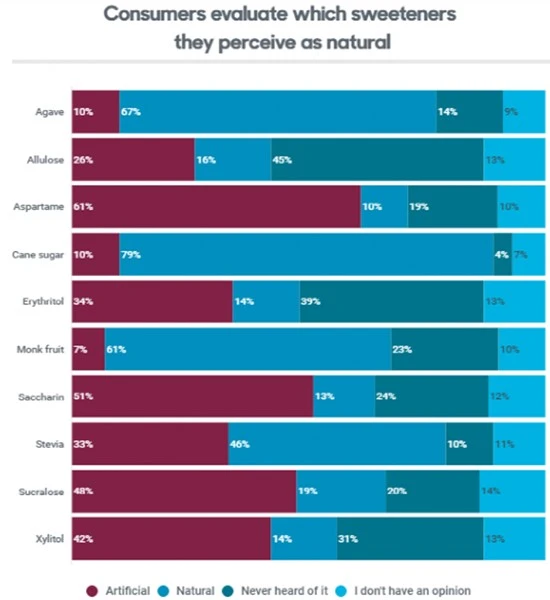
Consumer Awareness of Sweeteners
Luo Han Guo is usually added to food and beverage in the form of Luo Han Guo extract. At present, the main application cases of Luo Han Guo abroad are as follows.
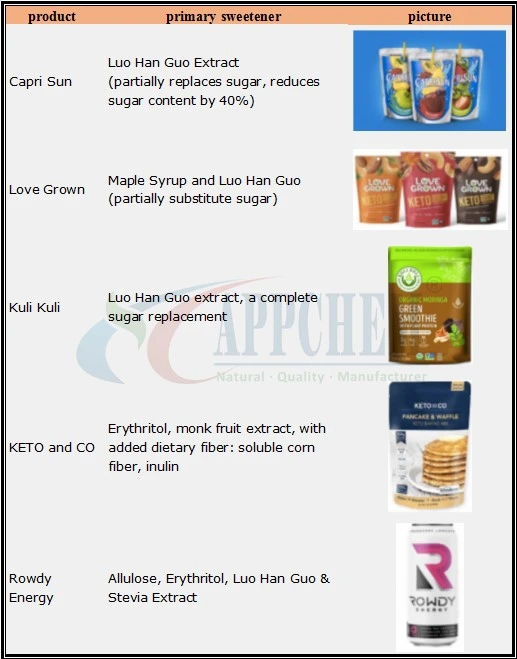
Stevia
In December 2008, stevioside Reb A passed the GRAS certification of the US FDA and can be used as a sweetener in food and beverages. Since then, the stevioside market has shown exponential growth. Innova Market Insights data shows that from 2016 to 2020, the number of products containing stevia launched globally has increased by more than 16% per year. The global stevia market was US$637.1 million in 2018 and is expected to reach US$1.1694 billion by 2026. According to Ingredion’s internal analysis, the global stevia market is estimated to exceed US$1.6 billion by 2028.
The sweetness of stevia is 200~300 times that of sucrose, but it does not produce energy. There are 13 main glycoside forms of steviol glycosides, namely: stevioside, rebaudioside A~F, M~O (Reb A~F, M~O), dulcoside A, rubusoside and steviolbioside. Steviol glycoside Reb A has a certain after-bitterness, and Reb M can perfectly solve the problem of steviol glycoside after-bitterness, but the content of this component in stevia is very small, and it is difficult to achieve commercial-scale production.