

As a fruit widely grown and consumed worldwide, apples not only have a good taste, but are also rich in various bioactive ingredients that have significant health benefits. The apple extract industry attaches great importance to the research and application of active ingredients in apples. There are differences in the content of active ingredients among different apple varieties due to their genetic background, cultivation environment, and other factors.
1. Overview Of The Main Active Ingredients In Apples
The active ingredients in apples primarily include polyphenols (such as anthocyanins, chlorogenic acid, epicatechin), flavonoids (including quercetin), vitamins, minerals, and dietary fiber. These ingredients endow apples with various physiological functions such as antioxidant, anti-inflammatory, and cardiovascular protection.[1-2] In the plant extract industry, polyphenols and flavonoids have attracted the most attention due to their high activity and wide application prospects.

2. Differences In Active Ingredients Between Different Varieties Of Apples
2.1 Variety differences in anthocyanin content
Anthocyanins are important polyphenolic substances in apples, known for their powerful antioxidant properties. Research indicates that procyanidin content varies significantly across apple varieties.

①Red Delicious: Studies have shown that the anthocyanin content in the peel of Red Delicious apples is relatively high. A study using the HPLC method found that the content of anthocyanin B2 in the peel of Red Fuji apples was at a relatively high level among several apples, ranging from 275.24 to 548.42 μ g/g, while the content in the flesh was 90.19 to 247.06 μ g/g.[3] Another study pointed out that the mature fruits of 'New Red Star' and 'Fuji' (a type of Red Fuji) have a high content of anthocyanins, with a concentration of 4.232-7.307mg/g (FW) in the peel and 0.525-1.034mg/g (FW) in the flesh.[4]
②Gala: Compared to some wild varieties or specific cultivated varieties, Gala apples may have relatively lower levels of anthocyanin content. Research has found that the content of chlorogenic acid, anthocyanin B2, and epicatechin in the flesh of Xinjiang wild apples (Malus sieversii) is much higher than that of locally cultivated varieties such as Gala.[5] Among them, the content of anthocyanin B2 in some strains of Xinjiang wild apples is significantly higher than that in Gala varieties.
③Green apples (such as green snake fruit): Green apples typically have a more sour taste, and their active ingredient content also exhibits distinct characteristics. The content of anthocyanins in green snake fruit (2.35%) was significantly higher than that in red Fuji (0.92%), indicating that green apples may have advantages in certain polyphenol components.
The differences between wild and cultivated varieties deserve special attention. A study on 25 Xinjiang wild apples and 3 local apple varieties (including Gala) showed that the content of 9 flavonoids detected in the flesh of Xinjiang wild apples was much higher than that of locally cultivated varieties. For example, the epicatechin content of certain strains of wild apples in Xinjiang (such as GL183) is even 82.13 times higher than that of Gala.[5] Twelve types of flavonoids, including procyanidin B1, B2, and B4, were also detected in six small apple varieties (such as Longshuai, Longhong, and Longqiu) in Northeast China. The content of epicatechin ranged from 10.20 to 73.77 mg/kg, with significant differences among different varieties.[6]
2.2 Variety differences between phenolic acids and flavonols
In addition to anthocyanins, there are also differences in other polyphenolic substances among different varieties.
Phenolic acid: Chlorogenic acid is one of the main phenolic acids in apples.[2] Research has found that chlorogenic acid is the most abundant monomeric phenol in non-concentrated reduced apple juice (NFC). The content of chlorogenic acid in the flesh of Xinjiang wild apples is also much higher than that of the locally cultivated variety Gala.[5]
Huangketol (such as quercetin and rutin): Studies on Northeast small apples have shown that the content of quercetin derivatives, such as quercetin galactoside and quercetin glucoside, varies greatly among different varieties. For example, the content of quercetin galactoside ranges from 5.36 to 88.38 mg/kg, and the content of quercetin glycoside ranges from 11.82 to 49.64 mg/kg. These flavonol components contribute to the overall antioxidant activity of apples.
2.3 Variety differences in antioxidant capacity
The differences in active ingredients directly lead to varying levels of antioxidant capacity among different varieties of apples.
A study specifically compared the polyphenol composition and antioxidant capacity (measured by DPPH and ABTS free radical scavenging ability) of 15 NFC apple juices and found that:
The DPPH free radical scavenging ability of "Jonagin" apple juice is the highest (89.1%).
The ABTS free radical scavenging ability of "Qiuxiang" apple juice is the strongest (92.6%).[2]
The study also demonstrated that anthocyanins are the main contributors to the in vitro antioxidant capacity of NFC apple juice. Especially, the three monomeric phenols of Procyanidin B2, epicatechin, and epicatechin gallate exhibit strong DPPH free radical scavenging ability; The ABTS radical scavenging ability is more dependent on the total phenolic content.
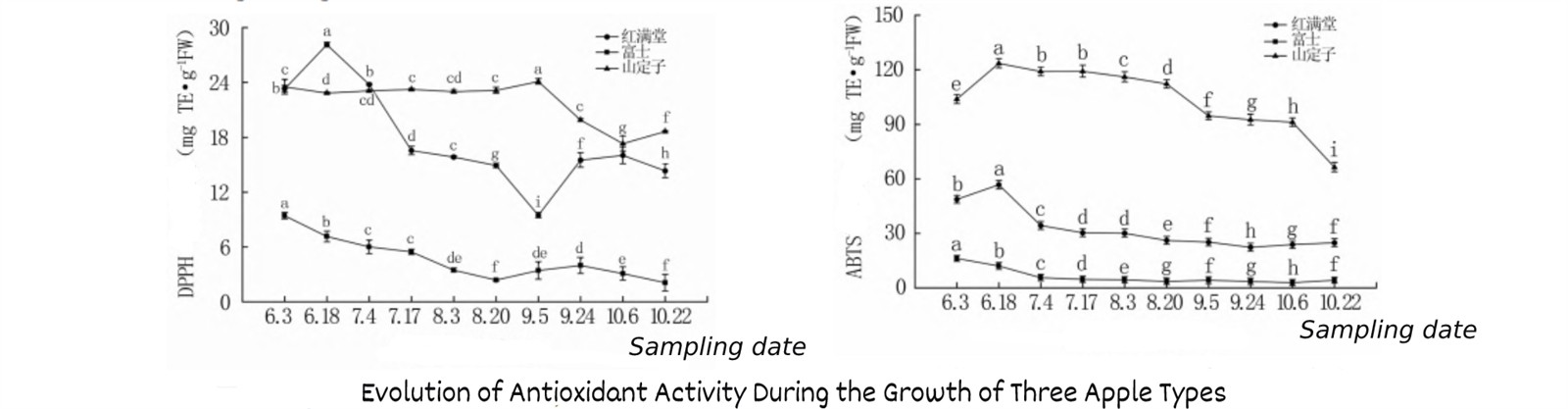
Another study compared the antioxidant capacity of Yamagata, Hongmantang (red skin and red meat), and Fuji apples at different developmental stages and found that the antioxidant capacity was as follows: Yamagata>Hongmantang>Fuji.[1] And there is a strong positive correlation between the content of phenolic substances and antioxidant capacity.
3. Factors Affecting The Content Of Active Ingredients In Apples
The content of active ingredients in apples depends not only on the variety, but also on various factors:
- Fruit parts: The distribution of active ingredients in various parts of apples is extremely uneven. Multiple studies have consistently shown that the content of polyphenols (such as anthocyanins and flavonols), total phenols, and total flavonoids in fruit peels is significantly higher than that in fruit pulp.[3-4] For example, it is reported that the total polyphenol content in the peel of "Golden Crown" apple (115.52mgGAE/100g) is more than 2.6 times that of the flesh (44.33mgGAE/100g); The total flavonoid content of fruit peel (291.19mg/100g) is more than 3.3 times that of fruit pulp (87.38mg/100g). The total flavonoid content in the peel of "Red Fuji" apples (617.86mg/100g) is much higher than that in their seeds (84.05mg/100g) and flesh. Therefore, it is crucial to fully utilize the skin and even fruit residue during processing and extraction.
- Fruit development stage: The content of active ingredients changes dynamically with fruit development.[4] Research has found that during the fruit development of 'Fuji' and 'New Red Star', the content of anthocyanins in the peel increases in the early stages of development, reaching its highest value at the end of May, then decreases, and stabilizes after mid July; The content of anthocyanins in the fruit pulp has been decreasing and has remained stable since mid August. A study has also clearly shown that the total polyphenol, flavonoid, anthocyanin, and antioxidant capacity of apples are higher in the young fruit stage, and the active ingredients demonstrate a decreasing trend with the development process. The content of anthocyanins increases with the development of the fruit.
-
Region and environment: Apples from different areas, even if of the same variety, may have differences in their active ingredients due to factors such as climate, soil, and cultivation methods. The research on wild apples in Xinjiang and small apples in Northeast China has revealed the uniqueness and diversity of active ingredients in apple resources from different regions.[5-6]
4. Insights and Applications for the Plant Extract Industry
The significant differences in active ingredients among different apple varieties provide important directions and challenges for the plant extract industry:
4.1 Selection of raw material varieties: The industry should accurately select apple varieties based on the target active ingredients. If high altitude anthocyanin content extracts are needed, priority can be given to specific strains of Red Fuji, Xinjiang wild apples, or green apples. If attention is paid to chlorogenic acid or epicatechin, the potential of wild apple resources in Xinjiang is enormous. It is crucial to establish a clear traceability system for raw materials, including variety, origin, and harvesting period.
4.2 The focus of processing parts: Given that the active ingredient content in the peel is much higher than that in the flesh, the production of extracts should prioritize the use of apple processing by-products (such as peel and pomace). This enhances extraction efficiency and economic value while aligning with the concept of the circular economy.
4.3 Optimization of process technology: The extraction process of different active ingredients must be optimized specifically. For example, the detection of anthocyanin B2 is often carried out by the HPLC method, with chromatographic conditions of Phenomenex Luna C18 column; Mobile phase A: 0.5% phosphoric acid solution, phase B: water acetonitrile (50:50, V/V); Flow rate: 1.0mL/min; Column temperature: 30 ℃; Detection wavelength: 280nm. In production, it is necessary to explore extraction, separation, and purification technologies that are suitable for large-scale, high-efficiency, and can maximize the retention of activity.[3]
4.4 Standardization and certification of products: Due to the variability of natural products, the industry needs to strengthen quality control, establish standard content ranges based on scientific data, and ensure the stability and reliability of the potency of different batches of products. At the same time, in-depth research on the bioavailability and clinical efficacy of extracts from different varieties provides a solid basis for product development.

Advances in molecular biology, metabolomics, and other technologies will deepen our understanding of the biosynthetic pathways and regulatory mechanisms of active ingredients in apples, facilitating the breeding of new varieties with enhanced bioactive content. The in-depth exploration of the human health efficacy mechanism of apple extract will also further expand its application in high-value-added functional foods, health products, cosmetics, and other fields. For more details, please connect with Serrisha from APPCHEM. (Email:cwj@appchem.cn;+86-138-0919-0407)
Reference:
[1]Guo Ziwei, Hou Wenhe, Fu Hongbo. Changes of Phenolic Substances and Antioxidant Capacity during Fruit Development of Different Apple Varieties[J]. Shandong Agricultural Sciences, 2021, 53(11):35-44. DOI:10.14083/j.issn.1001-4942.2021.11.006.
[2]Wang Yangi, Guo Yurong, Wang Yongtao. Analyses of Phenolic Composition and Antioxidant Activities of NFC Apple Juices from Different Cultivars[J]. Journal of Chinese Institute of Food Science and Technology, 2020, 20(05):74-83. DOI:10.16429/j.1009-7848.2020.05.010.
[3]Wang Jiao, Song Xinbo, Liu Chenghang, Liu Dailin. HPLC Determination of Proanthocyanidin B2 in Different Varieties of Apples[J]. Food Science, 2012, 33(24):293-295.
[4]Nei Lanchun, Sun Jianshe, Lv Xia. The contents and dynamic changes of procyanidin in the fruit of different cultivars of Malus domestica[J]. Journal of Plant Resources and Environment, 2004, (01):16-18.
[5]He Tianming, Ni Weiru, Liu Qing. Analysis on Kinds and Contents of Flavonoids in Xinjiang Wild Apple Fruits[J]. Shandong Agricultural Sciences, 2017, 49(03):46-51. DOI:10.14083/j.issn.1001-4942.2017.03.009.
[6]Liu Chang, Zhao Jirong, Wang Kun. Analysis of Flavonoid Components and Contents of Different Apple Fruits in Northeast China[J]. Forest By-Product and Specialty in China, 2020, (05):25-28. DOI:10.13268/j.cnki.fbsic.2020.05.007.